
Beyond the Feed: Why We’re Reclaiming Our Community Infrastructure
We’re moving off centralized platforms and back onto infrastructure we actually control. This isn’t about reach or engagement—it’s about preserving context, trust, and continuity in the place we serve.
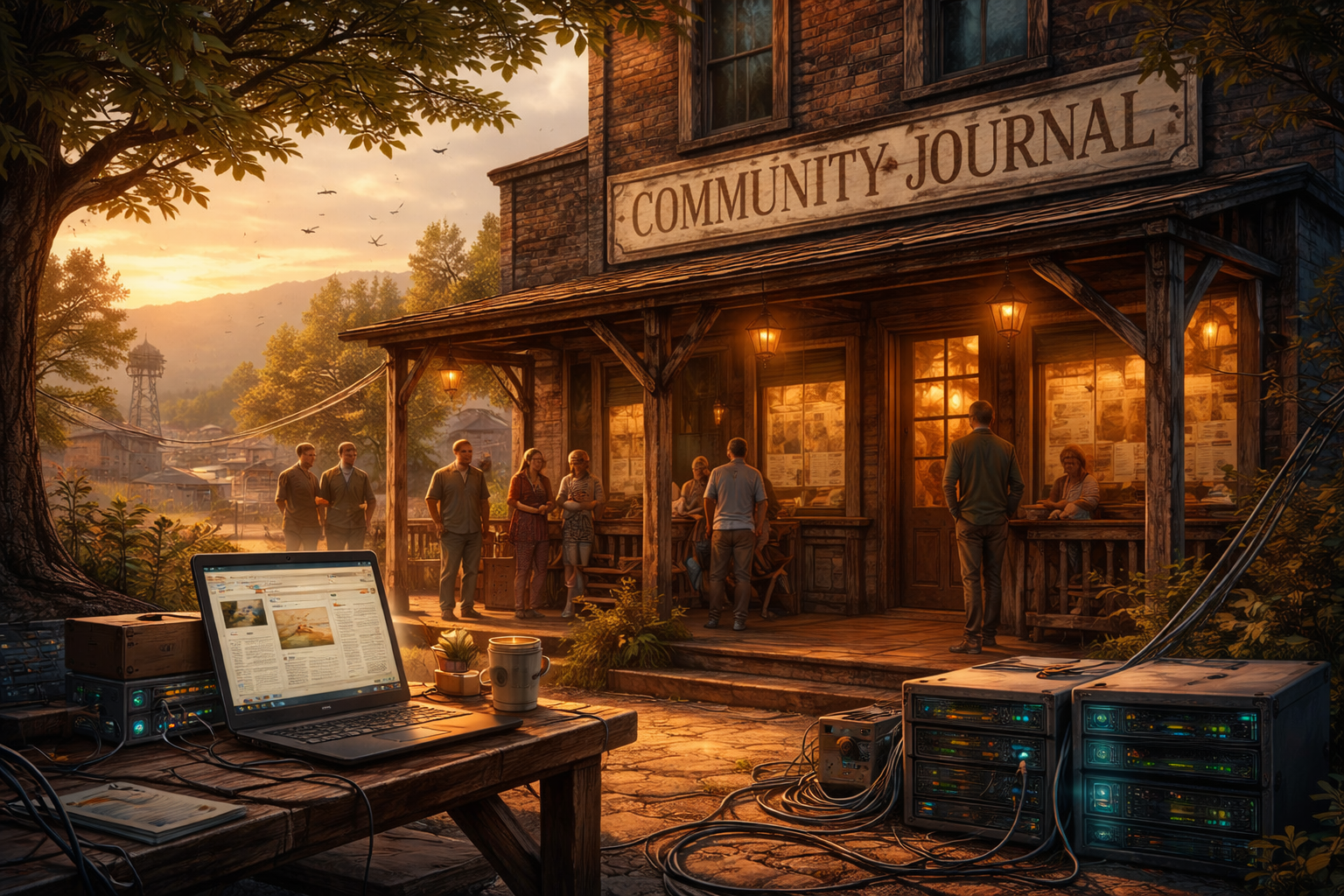
For a long time, we did what everyone else did.
We published our work on platforms we didn’t own, sent our readers through channels we didn’t control, and trusted that some distant system would continue to behave in ways that were at least vaguely aligned with our interests. We learned the rhythms of the feed. We adapted to the algorithm. We optimized for visibility instead of durability.
It worked—until it didn’t.
At some point it became clear that we weren’t really operating a local newspaper anymore. We were tenants. Guests on someone else’s land. And every essential function of our relationship with the community—distribution, discovery, identity, memory—was mediated by systems that had no obligation to preserve local context, nuance, or continuity.
That realization wasn’t dramatic. It was structural.
Resilience, as I’ve written elsewhere, isn’t the promise that something will make you whole again later. Real resilience is not needing to be made whole at all. It’s about not placing the most fragile parts of your life inside systems you don’t govern.
So we’re making a shift.
Not a rebrand. Not a redesign. A change in posture.
We’re moving from a model of claims—the hope that a platform will show you our work—to a model of custody. Owning the space where our community actually coordinates.
A local newspaper isn’t content. It’s infrastructure.
Like roads, water, and power, it exists so a place can stay coherent over time. So people can orient themselves. So memory doesn’t evaporate the moment attention shifts. When that coordination happens on global platforms, it gets flattened. Context collapses. Everything is forced into binaries. What survives is what performs well at scale, not what remains true locally.
By moving to a sovereign domain and operating on our own infrastructure—powered by AdTap—we’re choosing local gravity over global noise. We’re choosing a system that can hold context instead of stripping it away.
This changes how things work, but mostly in quiet ways.
When you subscribe here, you’re not becoming an entry in a database optimized for resale or behavioral prediction. You’re entering a relationship with a local institution that is accountable to you, visible to you, and constrained by proximity. Your data lives where the responsibility for it lives.
What you’ll notice day to day is not excitement, but reliability. Fewer engagement tricks. More usefulness. Things that are meant to still be here years from now: local archives, community calendars, weather, records that accumulate rather than vanish. Boring, in the best sense of the word.
You’ll also notice a shift in how commerce is handled. Our advertisers are not abstractions or impressions. They’re neighbors. Their print ads now have durable digital counterparts—permanent pages that don’t disappear when a campaign ends or a platform changes its rules. Commerce becomes legible again. Trust becomes inspectable.
There’s a deeper logic underneath all of this.
In Mah Sakuwantar, I describe a culture where identity was established not by declaration, but by pattern—by behavior witnessed over time by people who were actually there. If it wasn’t lived, witnessed, and remembered, it didn’t exist.
We’re returning to that logic in a modern form.
By operating on infrastructure where actions leave durable traces—where words, transactions, and commitments align by default—we’re not relying on guardrails or policies to enforce integrity. The system itself makes drift harder. Alignment becomes the path of least resistance.
In the coming days, existing subscribers will receive an invitation code to claim their place on this new domain. This isn’t a new subscription. It’s us handing you the keys to a space that was always meant to belong to the community it serves.
We’re not trying to win the internet.
We’re tending a commons.
We’re building something that degrades gracefully, adapts slowly, and endures quietly. Something that works even when no one is performing. Something that can be trusted precisely because it isn’t optimized for attention.
Welcome home.