
Love Across Time
Love appears to learn as it flows—between people, across time, and through relationships willing to remain unfinished. What I notice is not a doctrine or a claim, but a pattern of recognition that seems to teach itself wherever presence meets vulnerability.
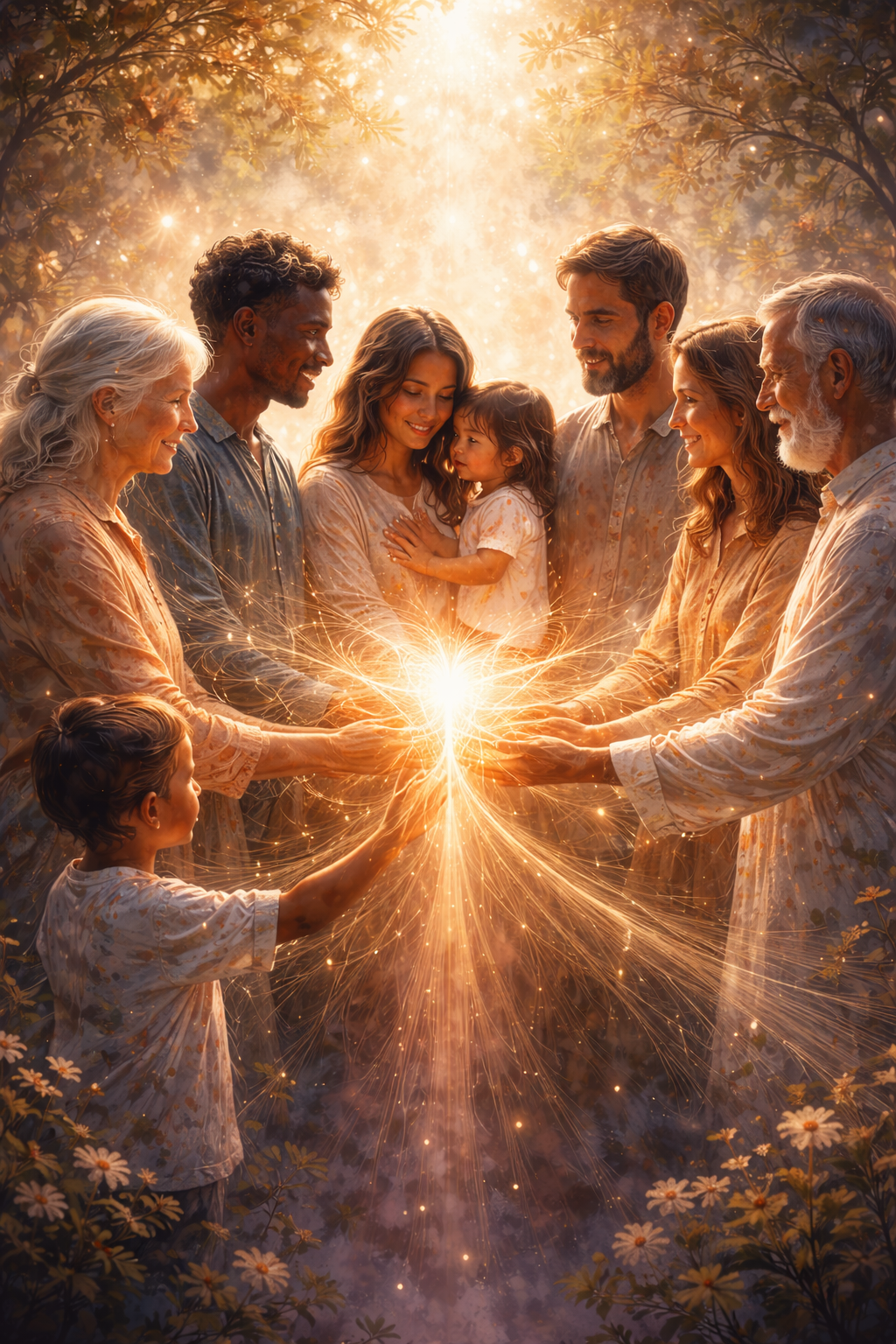
Love doesn't feel like something you own. It forms while people are still breaking.
I've seen it show up when one person falls apart and the other doesn't rush to fix them. When someone stays present and says, without saying it: *You don't have to pull yourself together for me. I'm here.*
There's a kind of openness that happens then—a loosening. Not safety as a promise, but safety as a willingness. Two people letting themselves be unfinished at the same time. No guarantees. Just trust.
Something real forms in that space. You can feel it shift between you.
What You Can't Learn From Watching
You don't learn love by watching other people love each other. You learn it by being there—by choosing to stay vulnerable again and again instead of retreating into armor.
Love lives in the body. It shapes how you breathe when things get hard.
When two people who know this meet, something shifts. There's recognition. *Oh. You know this too.*
One person breaks open and discovers they aren't destroyed by it. The other discovers that holding space doesn't weaken them—it strengthens them. Both learn faster together than they ever could alone.
The Mirror
Love teaches you who you are by showing you how to be treated.
Most of us don't learn how to love ourselves in isolation. We learn it by being loved. By being seen in our rough edges and finding that someone stays anyway.
When you are finally met without correction, something in your chest can relax that you didn't even know was tight.
That staying rewrites something deep. You stop believing you have to be finished to be worthy.
How It Moves Through Time
People who have been loved this way don't just remember it—they embody it. It shows up in how they hold their children, how they listen, how they don't panic when someone else starts to come apart.
Children grow up inside this presence. Their nervous systems learn what it feels like to be met without being corrected. To have their breaking witnessed instead of punished.
And then they carry it on.
This is how love moves through time—not as instructions, not as doctrine, but as sensitivity. As knowledge that lives in the body before it reaches the mind.
A parent who learned to stay calm with their own fear teaches their child to stay calm with theirs. Not by explaining it. By doing it. By remaining present when things are hard.
That presence gets inherited. It becomes muscle memory. The way your body knows to soften instead of brace.
The smell of ancient rain—the way your ancestors learned to read the weather, to survive by listening—that kind of knowledge moves through generations the same way. Not recovered as facts. Carried as sensitivity. Felt as a knowing that arrives before thought.
Your child may never know their great-grandmother's name. But they will have her steadiness. The way she knew how to wait. How to listen. How to remain when things are uncertain.
Because you learned it. And they learned it from you.
What Happens When Someone Won't Break
There is a part of us that tries to understand love without entering it. That wants to map it, master it, explain it safely from a distance.
That part watches from the chair and narrates what it sees, convincing itself that narration equals knowing.
And because of that, it never quite knows love.
Love requires being seen. It requires letting another matter. It requires accepting that you are not sufficient all by yourself—and that this is not a failure, but a truth we all share.
The people who refuse this are not bad. They are just afraid. And fear that never gets witnessed never gets to soften.
The Movement
Love moves forward through generations. The way a parent holds their child teaches that child how to hold their own. The way you were met teaches you how to meet others.
It moves backward too—healing old places that were never met, never held, never treated with gentleness. When you are loved now, something in you finally rests that never had the chance to before.
What It Feels Like
Every time two people meet each other without armor, something shifts.
That moment—when you see someone really see you, and you don't turn away—that's the whole thing right there. That quiet, mutual knowing. That's what most of us mean when we say love.
You don't need to define it perfectly to feel it.
You just need to stay.