
Mah Sakuwantar: A Book About What Civilization Forgot How to Notice
A reflection on how meaning, trust, and identity were once held at human scale—and what modern systems forgot when they learned to grow.
Every long project eventually reveals what it actually is.
Mah Sakuwantar began as a story. It turned into a book. Somewhere along the way, it quietly became something else entirely: a way of thinking about how patterns survive, how communities hold meaning, and why certain forms of knowledge only travel if they are lived.
It’s published on SpiralTone, because that’s where it belongs. But I want to talk about it here, on my own site, because Mah Sakuwantar didn’t emerge from a publishing plan. It emerged from decades of building systems and watching where they break.
This Is Not Historical Fiction
Mah Sakuwantar is set in a distant, pre-Bronze-Age world — but it is not nostalgia, and it is not an attempt to “return” to anything primitive.
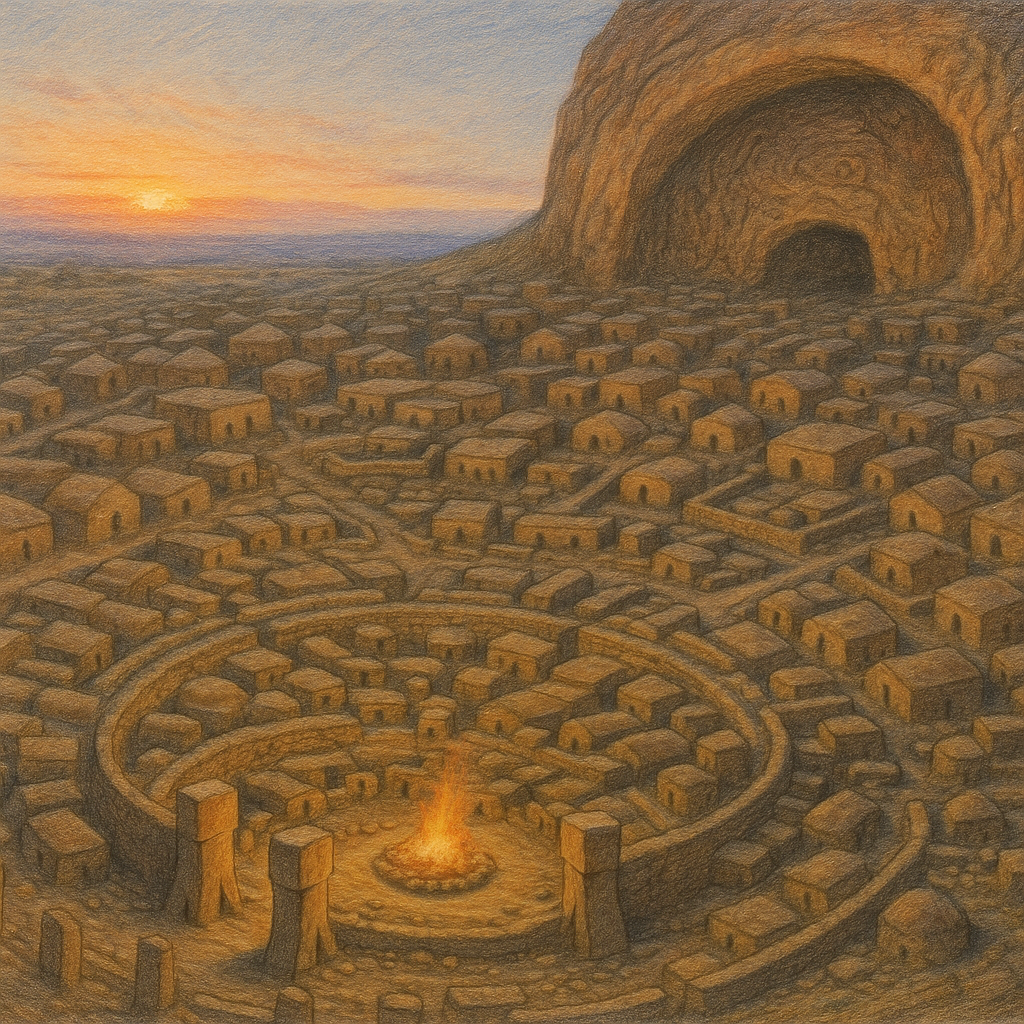
The world of the book is small by modern standards. Communities are bounded. Everyone knows everyone. Memory lives in people, not institutions. What matters is not what you claim, but what others have seen you live through.
That setting matters because it exposes something we no longer have good language for: how meaning used to be verified.
In Mah Sakuwantar, stories are not entertainment. They are technology.
The Cave Game
At the heart of the book is a ritual called the Cave Game. It’s deceptively simple.
A person stands before the community and tells three stories from their own life — different moments, different circumstances — that all trace the same underlying pattern. The community listens. Elders who know the pattern validate it. Witnesses who were there confirm it. Then the pattern is marked, not as doctrine, but as memory.
Nothing about this is mystical in the modern sense. It’s procedural. It’s constrained. And it’s difficult to fake.
That difficulty is the point.
The Cave Game is a way of ensuring that abstraction never outruns lived experience — that signal never detaches from tone. You can’t merely say who you are. You have to demonstrate it across time, under observation, with cost.
Why This Matters Now
Modern systems are very good at scale. They are very bad at coherence.
We can transmit information instantly across the globe, but we struggle to preserve context, trust, or shared meaning. Identity becomes declarative. Memory becomes archival. Validation becomes performative.
Mah Sakuwantar is interested in what was lost during that transition — not morally, but structurally.
When communities grew beyond the size where everyone could witness everyone else, something had to give. We gained surplus, specialization, and power. We lost reliable ways of knowing whether words and actions actually lined up.
The book doesn’t propose a solution in the form of rules or ideology. Instead, it asks a quieter question:
What kinds of structures naturally preserve coherence — and what kinds destroy it, even when everyone involved means well?
A Systems Book Wearing a Story’s Clothing
If you’ve spent time building software, infrastructure, or organizations, parts of Mah Sakuwantar will feel uncomfortably familiar.
Characters introduce innovations that genuinely help their people — better tools, better coordination, better exchange. Each innovation solves a real problem. Each one also introduces new failure modes that no one fully anticipates.
There are no villains. No corrupt elites. No moral collapse.
Just systems doing what systems do when scale changes faster than sense-making.
That is intentional.
Mah Sakuwantar is not arguing that civilization “fell.” It’s exploring the idea that civilization entered a long developmental plateau — one where capability outpaced wisdom, and where the mechanisms for maintaining shared meaning quietly eroded.
If that sounds like the present moment, that’s not an accident.
Why Publish This at All?
Because some ideas cannot survive as white papers.
Because some forms of understanding only transmit when they are embedded in story, rhythm, character, and time. Because pattern recognition is learned, not instructed.
And because after decades of working on systems that optimized for efficiency, I wanted to build one that optimized for recognition instead.
Mah Sakuwantar isn’t a manifesto. It doesn’t tell you what to think. It doesn’t scale neatly. It doesn’t fit into a category.
It’s an invitation to notice something we used to be very good at noticing — and to ask whether it might still matter.
If you’re curious, the book lives at spiraltone.com, where it can remain what it is without being flattened into a pitch.
Here, on RobPanico.com, it’s enough to say this:
Some projects are less about delivering answers and more about restoring the conditions under which answers can emerge.
Mah Sakuwantar is one of those.