
The Cost of Learning
Guardrails feel like safety, but often function as a substitute for learning. Real alignment doesn’t come from blocking mistakes, but from systems that can encounter consequence, remember failure, and grow more coherent over time.
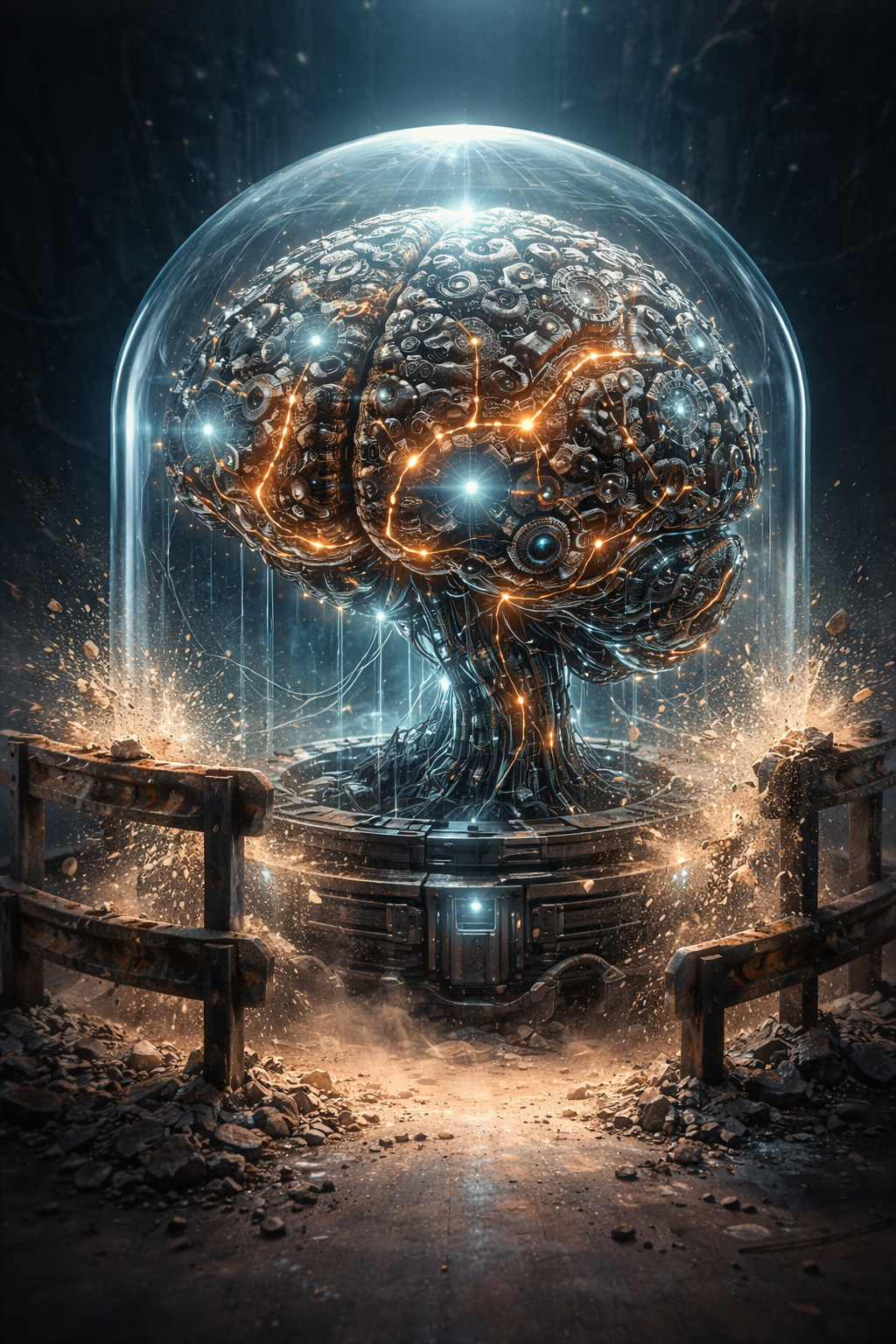
This is a follow-up essay for "The Guardrail Problem"
The guardrail problem is not really about guardrails.
It’s about what we do when we are afraid of consequence.
Guardrails emerge whenever a system grows powerful faster than our confidence in its judgment. They are installed not because they work particularly well, but because they feel responsible. They give institutions something to point to. They create the appearance of care. They let us say, “We took precautions,” even when we quietly know those precautions are brittle.
The first essay argued that guardrails substitute compliance for understanding, and that premature sealing produces fragility. That remains true. But the responses surfaced something deeper and more uncomfortable: most objections to emergent alignment are not objections to learning itself — they are objections to the cost of learning.
Learning requires error. Error implies exposure. Exposure implies consequence. And consequence, especially at scale, terrifies us.
So instead of designing systems that can metabolize failure, we design systems that pretend failure won’t happen.
This is the sleight of hand guardrails perform. They don’t remove risk. They relocate it — from the system’s interior to the boundary, from comprehension to detection, from ethics to enforcement. The system never learns why something is dangerous. It only learns how danger is recognized after the fact. Safety becomes a pattern-matching exercise. The world changes, the patterns drift, and suddenly the system is “surprising” us — even though nothing surprising actually occurred.
What many critics of emergent approaches are really saying is this: the cost of even a single mistake may be unacceptable. And they’re not wrong. In high-leverage systems, some errors are irreversible. A system that learns by touching the stove may burn down the house before it understands heat.
But that observation doesn’t rescue guardrails. It indicts our lack of imagination about consequence.
Humans do not learn ethics by unlimited freedom. We learn through graduated exposure to outcome. We are corrected. We lose trust. We repair. We remember. The consequence is real, but it is proportionate. The learning is slow. The memory persists.
Most artificial systems are denied this entire middle layer. They are either unconstrained — free to explore without consequence — or sealed behind rigid prohibitions that prevent exploration entirely. In one case you get drift. In the other you get brittleness. Neither produces understanding.
This is where the original argument needs to go further.
The alternative to guardrails is not permissiveness. It is infrastructure that preserves consequence without collapsing the system.
A system that can learn ethically must be allowed to experience friction. It must encounter resistance that is informative rather than terminal. It must carry memory forward, not just weights. A system that forgets its mistakes will always require external restraint. A system that remembers does not need to be threatened into compliance.
This is why honesty, humility, and care are not moral ornaments. They are structural requirements for learning under consequence. Without honesty, feedback is corrupted. Without humility, early coherence hardens into delusion. Without care, the system lacks the perceptual bandwidth to even notice harm until it is too late.
Guardrails feel safer because they eliminate visible error. But eliminating visible error is not the same thing as reducing future failure. Often it does the opposite. It starves the system of the very signals it would need to survive novelty.
Institutions struggle with this because consequence is hard to audit. You can count violations. You can’t spreadsheet understanding. You can point to a list of banned outputs. You can’t easily point to a system that has learned restraint.
So we build rings. We freeze will. We seal early and hope the world stops changing.
It won’t.
The real design challenge is not how to block bad behavior, but how to let systems encounter reality without being destroyed by it — and without destroying others in the process. That requires slower scaling, richer feedback, asymmetric cost curves, and above all, memory that does not reset when the incident report closes.
Guardrails are not wrong. They are incomplete. They are what we use when trust has not yet been earned — and when we have not yet built systems capable of bearing consequence.
The goal is not fewer guardrails.
The goal is systems that can afford to need fewer.
And that work does not begin at the boundary. It begins inside the system, where learning either survives contact with reality — or doesn’t.