
The Gap
The gap between what a symbol promises and what its delivery produces is not a flaw in history — it is its constant companion. What determines whether an idea survives is not the purity of its vessel, but the willingness to see and maintain that gap rather than perform around it.
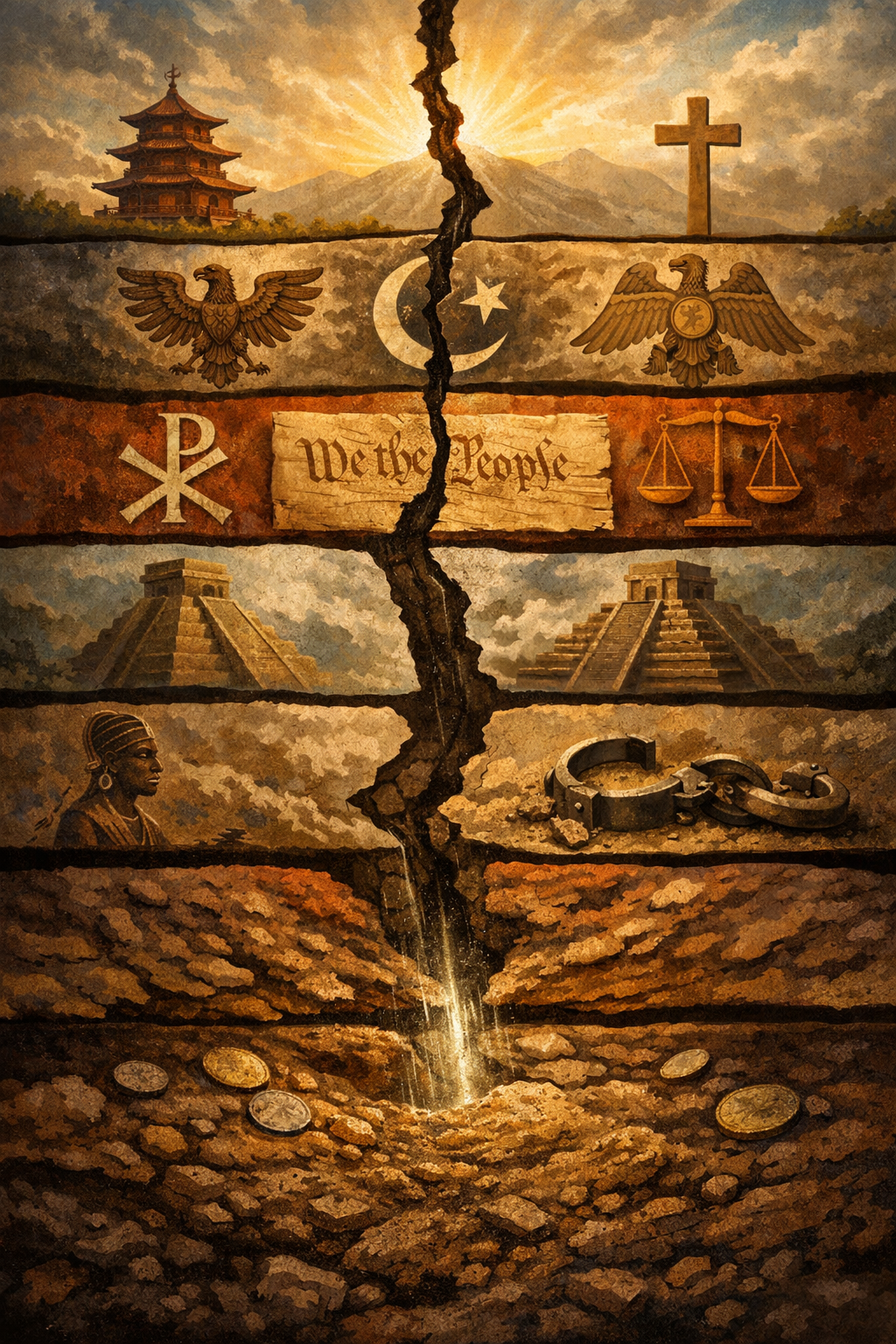
The Vessel
Human beings have always required symbols.
Not because we are corrupt, and not because we are weak, but because ideas do not move through history on their own. They require vessels. They require costumes. They require forms that can be recognized, trusted, and transmitted across time and distance.
A principle without a carrier remains local. A principle wrapped in a familiar symbol can travel.
This has always been true.
The question has never been whether symbols will be used. The question is whether the distance between the symbol and the substance remains visible — or whether it becomes something we quietly learn not to look at.
That distance — the gap between what is claimed and what is delivered — is not always malicious. Often it begins as necessity. But over time, it does something to the ground we stand on.
Movement One — The Mechanism
When an idea cannot win on its merits alone — because the world resists it, because the audience is not ready, because the opposition is too entrenched — its carriers face a choice.
They can wait.
Or they can wrap the idea inside a symbol that already commands loyalty.
The symbol may be religious. Constitutional. Cosmic. National. Moral. Scientific.
If the symbol is trusted, the idea gains entry.
And when this works — as it often does — it teaches something to everyone watching:
The costume is more powerful than the argument.
And once that lesson is learned, it rarely needs to be spoken again.
From that moment forward, the symbol itself begins to loosen. It becomes less a constraint and more a resource. Less a boundary and more a tool.
It becomes available to whoever needs it next.
Movement Two — The Pattern Across Time
The Mandate of Heaven may be the cleanest early example.
In ancient China, dynastic success proved divine favor. Whoever won demonstrated that Heaven approved. There was no falsification mechanism. Defeat retroactively meant Heaven had withdrawn its mandate.
The symbol did not prevent violence. It absorbed it. It rendered outcome indistinguishable from legitimacy.
The sediment formed early: power becomes righteousness.
The Aztec Triple Alliance carried a similar logic through a different costume. Cosmic obligation required tribute and sacrifice. Refusal was not merely political dissent — it threatened disorder in the universe itself. The symbol made resistance difficult even to frame. Those inside it could barely see its edges.
Constantine's conversion of Christianity introduced a subtler case. A persecuted faith, oriented toward transcendence and the dignity of the poor, became the religion of empire. The principle was not false. But its delivery through imperial machinery introduced contradictions that would surface only centuries later.
The lag between costume and consequence can be very long.
In the Abbasid translation movement, universal learning flourished under imperial patronage. Greek philosophy, mathematics, astronomy — preserved, translated, extended. But what survived did so because power found it useful. When patronage shifted, the intellectual inheritance shifted with it. The principle remained. What endured was what the vessel chose to carry.
Delivery determined what endured.
Buddhism in imperial China followed a similar arc. Court patronage accelerated its spread. Political usefulness shaped its institutions. Eventually, reform movements like Chan emerged in response — attempts to recover original signal from accumulated sediment. Not rejection of the principle. Recovery of it.
The Confucian examination system promised merit over birth. It genuinely oriented toward ability. Yet access to preparation often remained hereditary in practice. The symbol of meritocracy endured even as its delivery drifted quietly in the other direction.
Aksum adopted Christianity early and integrated it deeply into culture, language, and identity. Over time, that integration became a legitimating frame for imperial expansion. Not uniquely Western. Not uniquely cynical.
Structural.
The Mughal emperor Akbar's Din-i-Ilahi attempted something rare: universalism across Hindu, Muslim, Sufi, and other traditions. Its intention was genuine inclusion. Its medium was imperial authority. The delivery shaped the reception in ways the intention could not fully control.
Even sincere universalism moves through a vessel. The vessel matters.
In contrast, Islam in parts of Southeast Asia arrived primarily through trade rather than conquest. It adapted to local custom, merged with existing practice, translated rather than replaced. The inheritance looked different because the vessel was different.
This is not a corruption story. It is a shaping story.
Delivery does not inevitably distort. But it always determines what endures.
The Haitian Revolution embodied Enlightenment principles more radically than Europe itself had intended. The revolutionaries enacted universal liberty in a world that had spoken of it only abstractly.
Here the gap did not originate as internal contradiction. It was weaponized externally. The powers who proclaimed equality refused to recognize its application when it threatened their economic order. Reparations, isolation, and punishment reshaped the revolution's inheritance for generations.
Even when principle and delivery align honestly, surrounding structures can widen the gap by force.
Gandhi's ahimsa operated with unusual clarity. Nonviolence was not costume — it was philosophical conviction, rooted in traditions older than the conflict it entered. But it was also calibrated for visibility. It functioned within a global imperial audience that could be morally implicated by what it witnessed.
Here, principle and performance were not enemies drifting apart. They were consciously entangled. The medium did not corrupt the message, but it shaped its leverage.
The outcome was not purity. It was traction.
Ubuntu in post-apartheid South Africa offered another case. It was invoked sincerely by leaders who had endured profound harm. Mandela and Tutu understood what the word carried. Yet as political and economic structures hardened around the transition, the symbol of reconciliation was sometimes used to stabilize conditions that remained deeply unequal.
The gap did not begin in bad faith. It emerged in the sediment — the accumulated weight of what could not yet be changed, performed around until it began to resemble consent.
The American founding remains the most discussed example in the Western tradition, and perhaps the most instructive. "All men are created equal" written by slaveholders, ratified through compromise, secured through force. The principle endured. The contradiction endured with it, inseparable.
Reconstruction and the 14th Amendment built legal architecture intended for liberation. Over time, that same architecture was reinterpreted to protect corporate personhood and obstruct the reforms it was built to enable. The symbol remained constitutional equality. The delivery had shifted beneath it.
In the New Deal era, constitutional legitimacy itself became the central costume. Both factions performed fidelity to founding principles while fundamentally altering their interpretation. Neither believed it could win on the merits alone. The first successful use altered the medium permanently.
From that moment, the language of liberty expanded — not through philosophical argument settled in public, but through tactical retreat made under pressure. Positive liberty — the idea that freedom requires not just absence of interference but the real conditions to act — entered the discourse not as a conclusion but as a maneuver. The orientation was not wrong. But the delivery seeded contradictions that neither side fully intended and neither could easily undo.
Across centuries and continents — across civilizations that never knew one another — the mechanism repeats.
The gap accumulates.
Movement Three — The Sediment
Across these cases, the names and eras change. The costumes change. The intentions vary widely. But the pattern remains legible once you have seen it enough times to recognize its shape.
The important thing to notice is not dishonesty.
It is inheritance.
Each generation does not begin with a blank slate. It begins standing on layered performances it did not create, inside vessels it did not choose, speaking through symbols whose original constraints have already loosened. Arguments that once required justification arrive pre-wrapped. Positions that were once tactical feel, to those who inherit them, like bedrock.
Performance does not merely distort a moment. It sediments. It becomes ground.
Over time, the symbol drifts. It detaches from the constraint that once gave it force. What remains stable is the distance — the gap between what the symbol claimed and what the delivery produced.
The gap — the distance between principle and delivery — is what carries the truth forward.
Not the symbol itself. Not the costume. Not the rhetoric that traveled so efficiently across time.
The gap.
Because the gap cannot be entirely erased. It resists absorption. It resurfaces in reform movements, in crises, in reinterpretations, in the quiet discomfort of people who sense that something important has drifted without being able to name exactly when.
To acknowledge the gap is to preserve the possibility of learning.
To perform around it is to thicken the sediment.
Movement Four — The Choice
No idea arrives clean.
The choice is not between purity and performance. There has never been purity. Every principle that has ever moved through history has moved through a vessel, and every vessel has left marks.
The choice is whether the gap is acknowledged or concealed.
Systems that can name their founding contradictions remain adaptive. They can revise without collapse. They can absorb new information without losing coherence. The contradiction becomes a resource rather than a liability — a permanent reminder of the distance still to be traveled.
This is not the same as saying the vessel should be discarded. Acknowledging the gap is not an act of destruction. It is the only form of maintenance available to a system that must remain alive under pressure from time and change.
Systems that perform around their contradictions calcify. They must maintain the costume at increasing cost. They grow brittle beneath their own weight, until stress reveals what the performance had been concealing.
This is not moral instruction.
It is structural observation.
Honesty about the gap keeps an idea alive.
Performance slowly hollows it out from the inside — not dramatically, not all at once, but reliably, the way sediment builds: one quiet layer at a time.
Closing — The Present, Unnamed
Today's debates — about surveillance, about constitutional authority, about freedom and safety, about who belongs and who decides — are not new patterns.
They are new layers.
The costumes are contemporary. The mechanism is not.
It is tempting to wade into every argument. To correct every inconsistency. To win the battles that feel urgent. Sometimes that is necessary work. Sometimes the performance has to be met directly.
But sometimes the deeper work is quieter.
To see the sediment for what it is.
To recognize when a symbol is carrying more than it can bear.
To notice the gap — not with contempt for those who perform around it, but with understanding of how inheritance works, and how long the lag can be between costume and consequence.
And then to live in a way that would still make sense if the gap became visible to everyone at once.
Not as performance.
As alignment — before alignment becomes unavoidable.