
The Mind is Quick to Decide
Updated revision to the original which was published ten years ago.
Preface — 2016 to 2026
When I first wrote this essay in 2016, it was prompted by something simple: walking through familiar woods and realizing how quickly my mind wanted to finish the picture. A shape, a sound, a partial signal—and the story snapped into place before I had time to question it.
At the time, this felt like a personal observation about cognition and survival. In the decade since, it has become a public condition. The speed of decision has increased. The cost of being wrong has become more distributed. And the space between perception and certainty has narrowed to the point where many people no longer experience it as a space at all.
This revision doesn’t argue for slower thinking as a virtue. It argues for keeping the gap open—because that gap is where learning, correction, and humility still live.
Many parts of our county have been inhabited by human beings for a very long time. Long enough that the land itself occasionally returns evidence. As a child, I spent time walking fields and creek beds, looking for arrowheads and worked flint. When you find one, you’re not just holding an object. You’re holding proof that someone once stood where you’re standing, saw what you’re seeing, and made a decision that mattered.
Those early tools were shaped for survival. They existed in a world where perception and consequence were tightly coupled. Misidentify a sound in the woods and you don’t get embarrassed—you get injured or worse. In that context, the human mind evolved a powerful bias: decide quickly. Close the loop. Act.
That bias still runs.
Anyone who has spent time outdoors knows the feeling. You catch movement out of the corner of your eye. Your body tenses before your conscious mind has time to ask what it actually is. The mind does not wait patiently for more data. It completes the picture using whatever fragments are available and whatever past experiences feel close enough to match.
Most of the time, this works. Sometimes it saves your life.
But it also creates a persistent illusion: that what you first see is what is.
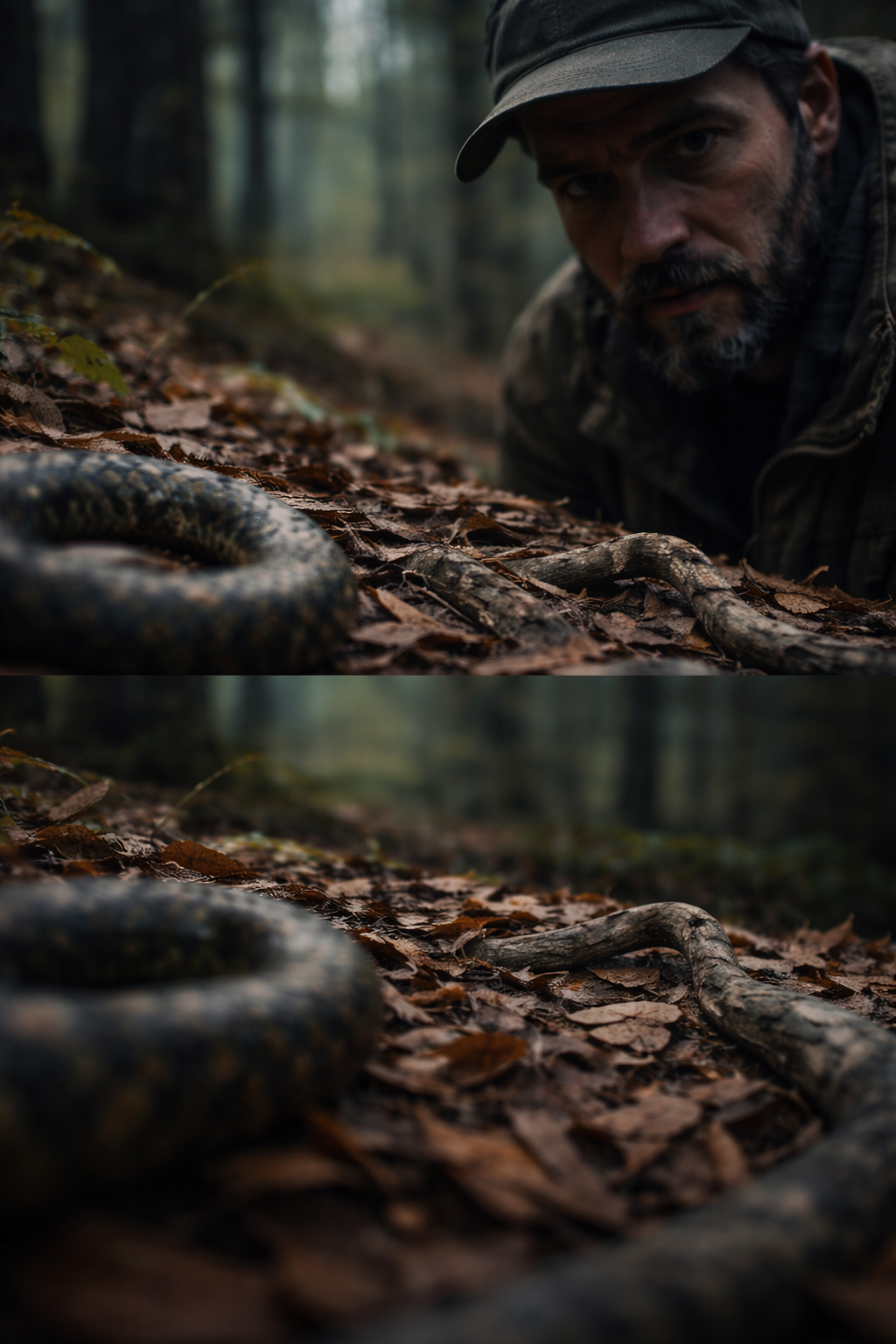
The danger isn’t that the mind decides quickly. The danger is that it decides quietly—without signaling that a decision has been made. The conclusion arrives feeling like perception itself. You don’t experience “I decided this was a snake.” You experience “snake.”
In the woods, repeated exposure teaches you something important. You learn that many “snakes” are sticks. Many “threats” are shadows. Over time, you develop a second skill alongside quick decision-making: the ability to reopen the picture. To pause, look again, and revise without panic or shame.
That skill is learned through consequence and repetition. It requires staying present long enough to be corrected.
In modern life, the conditions that once trained this capacity have largely disappeared.
Today, most of our perceptions arrive mediated—through screens, headlines, feeds, and secondhand accounts. The signals are partial by design. Context is compressed. Time pressure is constant. And the cost of being wrong is often social rather than physical. You’re rewarded not for accuracy over time, but for confidence in the moment.
The same cognitive machinery that once helped a human survive in the woods is now asked to interpret politics, economics, science, and other people’s intentions at planetary scale. The mind responds the only way it knows how: by filling in the gaps as fast as possible.
A headline becomes a motive. A statistic becomes a moral judgment. A single clip becomes a complete character assessment.
The speed feels like clarity. It isn’t.
What’s missing is not intelligence. It’s friction. The natural resistance that once forced us to test our perceptions against reality before sealing them into belief. In the absence of that resistance, the mind’s first draft hardens into certainty.
Once that happens, learning stops.
This is why disagreement now feels so absolute. It’s not merely that people hold different views. It’s that many people no longer experience their views as views. They experience them as direct perception. To question them feels like questioning eyesight, not interpretation.
And because the original decision happened invisibly, any challenge feels like an attack rather than an invitation to look again.
The problem compounds. When enough people operate this way simultaneously, entire systems drift. Policies are built on partial pictures. Institutions respond to shadows. Feedback arrives too late or is dismissed entirely because it conflicts with a story that already feels complete.
The mind is quick to decide—but it is also capable of revision. That capacity hasn’t disappeared. It has simply been starved of the conditions it needs to stay alive.
Those conditions are not ideological. They are structural. Time. Consequence. Repetition. Witnesses who can say, “I saw this too, and here’s what happened next.” Environments where being wrong is survivable and correction is possible without humiliation.
In the woods, you learn this naturally. In society, we now have to rebuild it deliberately.
The goal is not to eliminate fast judgment. That would be neither possible nor desirable. The goal is to retain access to the moment after the judgment—the quiet space where you can say, “This is my first read. It may not be the whole picture.”
That sentence is not weakness. It is competence.
An arrowhead pulled from the ground reminds us that human beings once lived close enough to reality to be corrected by it every day. Our tools have changed. Our scale has changed. The mind has not. If we want to navigate the world we’ve built without constantly mistaking shadows for snakes, we have to protect the one fragile interval that still makes learning possible.
The space between seeing and deciding.