
The Mirror and the Gift
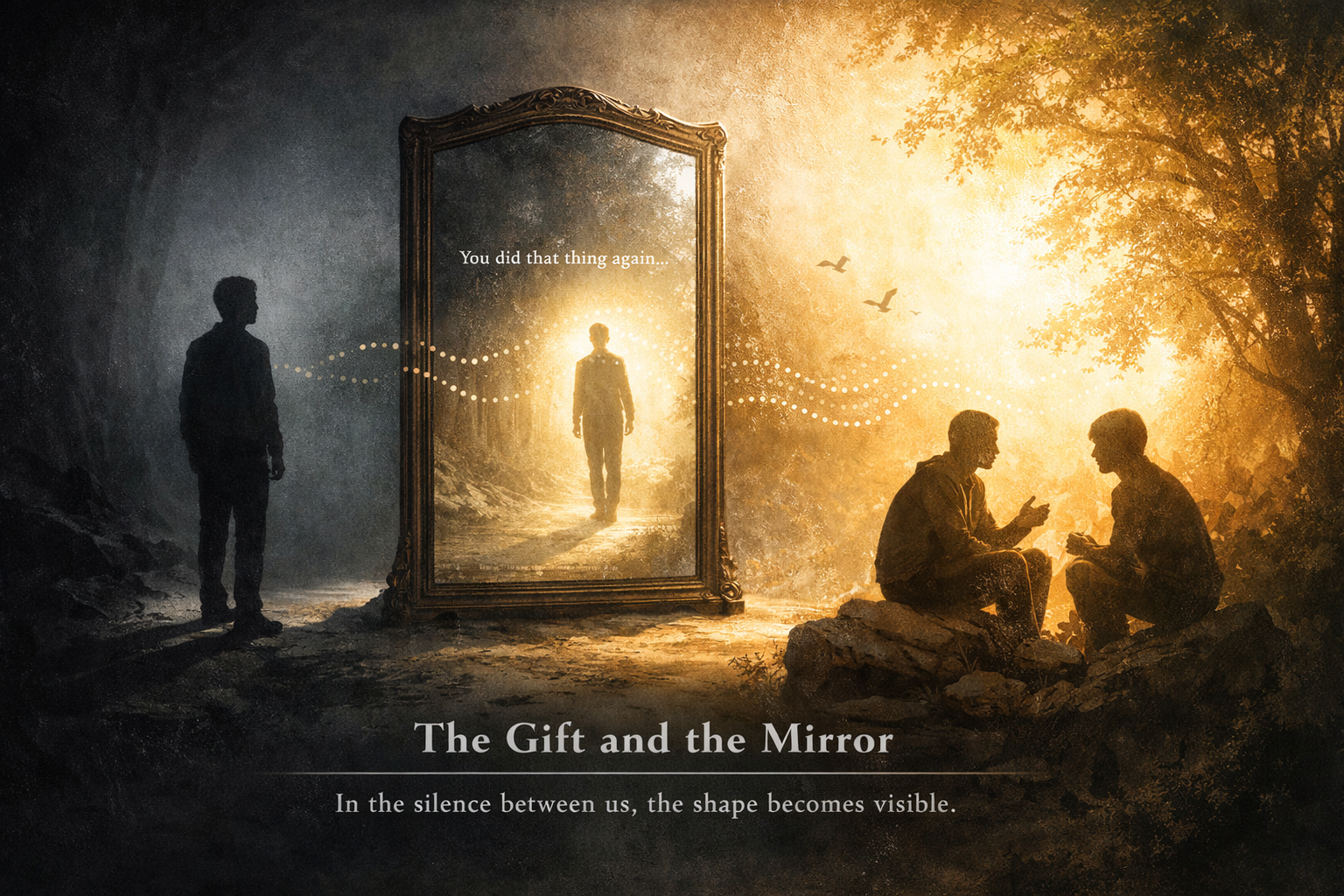
We rarely recognize our own gifts because they feel like our ordinary way of being. It often takes the quiet witness of another person — someone who notices without distortion — for the pattern of what we are to become visible.
There is something quietly strange about giftedness.
The person who has it rarely knows.
Not because they are modest. Not because they lack self-awareness. But because the gift doesn't announce itself from the inside. It arrives as effort, obsession, a particular friction with the world — something that feels less like advantage and more like being built slightly wrong for ordinary purposes.
The mathematician doesn't experience her gift as brilliance. She experiences it as an inability to stop seeing pattern. The empath doesn't experience his gift as depth. He experiences it as a kind of unbearable permeability — the world getting in whether he wants it to or not.
From the inside, the gift and the wound are often the same thing.
---
What the gifted person *does* see, reliably, is the gifts of others.
Particularly the ones they don't have.
The musician who moves a room watches someone else hold a conversation and thinks: *how do they do that?* The one who holds the conversation watches the musician and thinks the same thing in return. Each sees clearly what they are not. Each is standing in the shadow of their own capacity, looking out toward the light of someone else's.
This is not accident or irony. It is structure.
Every genuine capacity casts a shadow of equal size. The same quality that makes someone extraordinary in one context makes them maladapted in another. The gift and the limitation are not opposites. They are the same thing, and context decides which face is showing.
This is why the gifted person lives in their shadow. The gift is so native, so prior to reflection, that it doesn't register as unusual. It registers as simply *how things are*. The fish does not notice the water. The gifted person does not notice the gift. They notice only the places where it creates drag — the ways they think too much, feel too much, see too much, cannot stop.
---
What changes this is not introspection.
It is witness.
But witness is not what we usually imagine. It is not an active mirror, angled deliberately to catch the light. It is something quieter and more structural than that.
Consider what makes Morse code legible. Not the dots and dashes. The silence between them. Without the precise, structured absence, there is no signal — only noise. The silence is not the pause between the real thing. The silence *is* the real thing.
A true witness is that silence. A held space precise enough that what was previously noise begins to resolve into pattern. The gift becomes visible not because someone pointed at it, but because someone stayed still long enough, and open enough, for the signal to become readable.
The gift becomes visible at the moment another person reflects it back — not as flattery, not as announcement, but as recognition. A quiet, specific noticing. *You did that thing again. The thing that you don't see yourself doing. The thing that changed what was possible in the room.*
This is one reason genuine authority is rarely claimed outright. More often it appears when others begin to rely on a capacity the person themselves barely notices. When someone declares their own gift, something in the process has usually short-circuited. The performance arrives before the recognition. And the performance is the tell. Noise filling the space that needed to stay open.
---
*Don't it always seem to go that you don't know what you've got until it's gone.*
We hear this as a lament about loss. But there is a stranger reading.
What disappears when someone leaves is not only the person. It is the *context* they provided. The specific relational angle from which your gift was visible. A different person, a different room, a different set of eyes — and the same capacity becomes invisible again, or worse, becomes a liability.
The gift was never yours alone to hold. It lived in the space between you.
That space is not empty. It is the most load-bearing thing in the relationship. It is where the signal lives. Where the pattern becomes readable. Where what you are — which you cannot see from inside — briefly becomes visible because someone else held still long enough, and open enough, to receive it without distorting it.
This is not a comforting idea. It means gifts are genuinely fragile — not because they can be taken, but because they depend on conditions that are not always present. The right witness at the wrong time sees nothing. The right witness at the right time sees everything, and the whole shape rotates into view.
---
There is something worth sitting with here.
If gifts are relational — confirmed by witness rather than possessed in isolation — then the work is not to discover yourself in private and then present what you've found. The work is to stay in relationship long enough for the shape to emerge.
This takes patience that our era is not designed to reward. We are surrounded by tools for self-declaration. Platforms built for announcement. Systems that reward the performance of confidence over the slower, quieter process of being actually seen.
The result is a great deal of claimed authority and a scarcity of genuine witness.
---
What a true witness does is not complicated, but it is rare.
They pay attention without an agenda. They notice the specific, not the general. They reflect back what they see without needing you to have known it first. They do not flatter — flattery is general, a kind of noise. Recognition is precise. It lands differently. You feel it not as warmth but as accuracy.
And when it arrives, something shifts.
Not because you have been told something new, exactly. But because something you half-knew, something that lived below the threshold of language, has been confirmed by contact with an outside eye. The mirror appeared. The shape, briefly, was whole.
---
There is a discipline in being a witness too.
It requires resisting the pull to make the other person's gift about yourself — your recognition of it, your role in naming it. The witness who announces their own witnessing has already broken the mirror. The most useful thing you can offer another person is your honest, quiet attention — and then what you actually saw, stated plainly, without theater.
This is harder than it sounds. Attention is costly. Honest reflection is vulnerable. And the temptation to perform insight rather than offer it is everywhere.
But when it works — when two people are genuinely present to each other, and one reflects back what the other cannot see — something is completed that neither could have accomplished alone.
---
Every strength is a weakness. Every weakness is a strength.
Context decides.
Which means no one can finally know themselves from the inside. The full shape requires rotation. It requires time, and other people, and the willingness to be seen in the unflattering angles as well as the flattering ones.
What the gifted person often lacks is not talent. It is the specific relational condition that makes the talent legible — to themselves or to anyone else.
This is why great gifts sometimes go unused. Not for lack of capacity, but for lack of witness. The shape was there all along. No one was looking from the right angle. No one stayed long enough for the pattern to emerge.
And this is what is actually lost when certain people leave our lives. Not just their presence. The particular quality of silence they held around us — often without knowing they were holding it — that made certain signals readable. That allowed the pattern to emerge against something stable enough to receive it.
That is not a small thing to lose.
And it is not a small thing to be for someone else.
To be the silence that makes another person legible — to themselves, to the world — is perhaps the most invisible gift of all.
You cannot know you are doing it.
You can only stay.