
The Money Illusion (Revisited)
An updated revision to the original, published ten years ago.
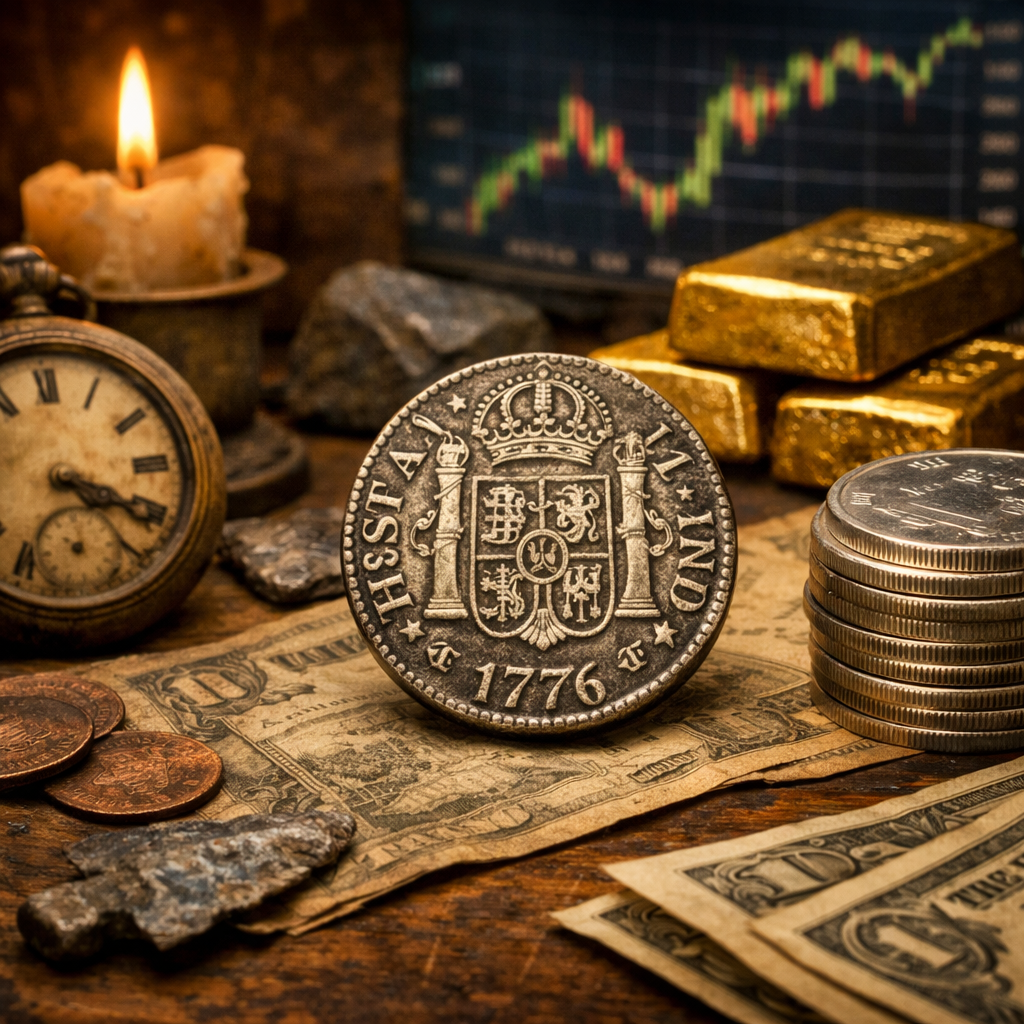
Preface — 2016 to 2026:
When I first wrote The Money Illusion in 2016, it was a modest meditation on coins unearthed here in upstate New York and on the deep stability once embedded in a precious-metals monetary standard. Back then, silver and gold were mundane benchmarks: something touched, held, and, for many decades, had a recognizably stable role in everyday life. In the decade since, those metals have migrated from background artifacts to frontier signposts in a monetary world that has fractured between nominal exchange and real store of value. A Spanish two reales coin from 1776 once aligned straightforwardly with human scales of exchange; today, an ounce of silver at roughly $110 and an ounce of gold at just over $5,000 underscore how disconnected nominal dollars have become from the real economic substrate people labor within.
Many parts of our county have been inhabited for so long that the ground itself returns reminders as worked flint: arrowheads and fragments shaped by hands now gone.
Practical objects, made to function in a real world. Some artifacts are less ancient, but equally revealing. A friend of mine, a hobbyist metal detectorist, has shown me coins recovered from soil that date back to the earliest years of the republic: copper coppers, a few silver pieces, private tokens from businesses long forgotten.
Some, astonishingly intact. One favorite is a Spanish silver two reales, minted in 1776 at La Casa de Moneda de México, sized exactly like a modern quarter—and for good reason. The early U.S. silver dollar was defined by the same weight and fineness as the Spanish “pieces of eight.” The coin you could have lost in this very field might once have been tender for everyday services, a shave and a haircut, a meal at a tavern, a sack of flour.
In that era, a monetary system tied to precious metals kept prices surprisingly stable across generations. A first-class postage stamp cost only a few cents for decades. Copper coins covered small expenses. There was even a small silver three-cent piece—the trime—minted to directly buy a stamp. That slow drift of purchasing power created an illusion of unity between the nominal value stamped on money and its real value in labor and goods.
That unity was an illusion, but it was a useful one. It trained minds to equate the unit of account with a constant measure, so that when prices changed it felt meaningful in a way that matched everyday lived experience.
All of that changed in 1971 when the United States formally abandoned the gold standard and all nations followed suit. Dollars today are a medium of exchange, but they no longer function as a stable store of value over time. Currency and money, once united, are now estranged. Prices are always in motion; the purchasing power of a dollar at any future date is not fixed.
That estrangement gives rise to the modern money illusion: the cognitive trap of thinking in nominal terms as though they carried constancy. Experiments show that people often regard a cut in nominal wages with no change in real purchasing power as unfair, yet accept nominal increases buried in inflation as progress—even when the real outcome is nearly identical. The fallacy is not stupidity. It is conditioning, bred by decades of living inside a shifting monetary substrate that conditions perception without training intuition.
Savings, which perform the money function of preserving value, now must take other forms: equities and bonds, real estate and private business ownership, commodities and futures, fine art, tools, collectibles, or precious metals. Even then, preserving real value often requires moving between these assets in anticipation of changing conditions. An ounce of silver today, at roughly $110, trades at a value that in raw commodity terms would pay for hundreds of basic services that once cost a mere quarter when tied to specie. Gold, at over $5,000 an ounce, trades at levels unimaginable to the early republic’s founders. These nominal figures are not measures of constant value—they are locations on a moving grid.
In such a system, ratios regain importance. Not the raw price of a dollar figure, but how that figure relates to real goods, services, and labor. How many hours’ wages buy a barrel of oil? How many ounces of silver buy a bushel of wheat? Today’s gold-to-silver price relationship—frequently expressed as how many ounces of silver one ounce of gold will buy—serves as a Topography of Value rather than a prediction: a narrative device that reveals which goods and assets are cheap or expensive relative to each other over time. The steepness and twist of these ratios tell stories that raw nominal prices cannot.
An old coin, long forgotten underground, reminds us that once money and meaningful value were not separate. Today’s precious metals prices tell us that nominal dollars alone are no longer enough to orient a person in economic reality. The unit drifts; only relations remain anchored. If you want to see where real value sits—and where it is going—you look not at the face value of currency, but at the ratios that connect labor, goods, and assets across time.
The illusion persists only so long as we mistake the unit for the thing it was meant to measure.