
The Prep You Can’t Buy
Discussions about preparedness tend to focus on supplies and self-sufficiency, but long emergencies reveal a different truth. When disruptions persist, survival depends less on what individuals have stored and more on the relationships they’ve already built. Trust, familiarity, and shared context become the real infrastructure—moving information, reducing fear, and enabling coordination when systems fail. Social capital can’t be rushed or improvised under stress; it accumulates slowly, long before it’s needed. In the end, the most durable form of preparedness isn’t isolation, but being embedded in a community that knows how to work together.
When people talk about preparedness, the conversation almost always drifts in the same direction.
It starts practical. Sensible, even. Food. Water. Power. Medical supplies. Redundancy. Then it thickens into gear talk, into tactics, into scenarios that feel half logistical and half cinematic. There’s a certain comfort in it. You can do something. You can measure progress. You can feel like you’re getting ahead of uncertainty.
None of that is wrong. But it’s incomplete in a way that only becomes obvious once emergencies stop being brief.
Short disruptions reward supplies. Long ones reveal something else entirely.
I was reading a discussion recently about disaster planning—ordinary people trying to think clearly about uncertain futures. It was thoughtful, grounded, well-intentioned. In the middle of all that, one idea cut cleanly through the noise: if an emergency lasts long enough, what determines how well you do isn’t what you’ve stored, but who you’re connected to.
That observation lands quietly, but it changes the entire frame.
Because once systems stay broken long enough, life stops being a matter of inventory and becomes a matter of coordination. Information matters more than equipment. Trust matters more than strength. Reputation matters more than readiness.
And those things behave very differently than supplies.
You can stockpile food. You can’t stockpile trust.
Trust only exists because of time spent before it was necessary. It’s built in ordinary moments, when nothing is at stake, when help isn’t transactional, when showing up doesn’t feel strategic. It forms slowly, almost invisibly, through consistency and presence and usefulness that isn’t performative.
That’s why it’s so easy to underestimate—and so hard to replace.
When conditions deteriorate, people don’t suddenly become more open. They become more selective. They narrow their circles. They rely on what they already know works. This isn’t selfishness; it’s cognitive triage. Verifying new people and new information is expensive when everything is unstable.
In those moments, social capital stops being an abstract idea and starts functioning like infrastructure.
It’s how information moves.
It’s how resources get shared instead of hoarded.
It’s how decisions get made without endless second-guessing.
A community that already knows how to cooperate doesn’t have to invent trust under stress. It can respond instead of freeze.
That’s the part that’s easy to miss if you think about preparedness as an individual project.
An isolated person has to integrate everything alone. Every signal, every rumor, every risk has to be evaluated internally. There’s no distribution of sense-making, no shared memory, no one else to say, “This feels familiar,” or “This isn’t new,” or “We’ve seen this pattern before.”
Communities absorb shock differently. They spread cognitive load. They dampen panic. They correct errors faster. Even when they disagree, they do so inside a shared context that keeps things from fracturing immediately.
This is why the fantasy of total self-sufficiency doesn’t survive contact with long emergencies.
It’s a comforting story—especially in cultures that prize independence—but it assumes a level of durability that human beings simply don’t have. Bodies get tired. People get sick. Attention degrades. Judgment wobbles. No amount of gear fixes that.
What does help is being known.
Being the person others recognize.
Being someone whose presence lowers friction instead of raising it.
Being useful in ways that aren’t flashy but are remembered.
Those qualities don’t show up on checklists. They don’t make for exciting forum posts. And they don’t feel urgent when life is still mostly comfortable.
Which is why people often realize their importance too late.
The timing problem is brutal. By the time it’s obvious that relationships matter more than supplies, everyone else has already tightened their circles. There’s no crash course in becoming trusted when scarcity and fear are already in the air.
That doesn’t mean it’s hopeless. But it does mean the work has to be done ahead of time, without certainty that it will ever be needed.
That’s what makes it real preparation.
Material readiness is finite. It depletes.
Social readiness compounds.
One runs down. The other adapts.
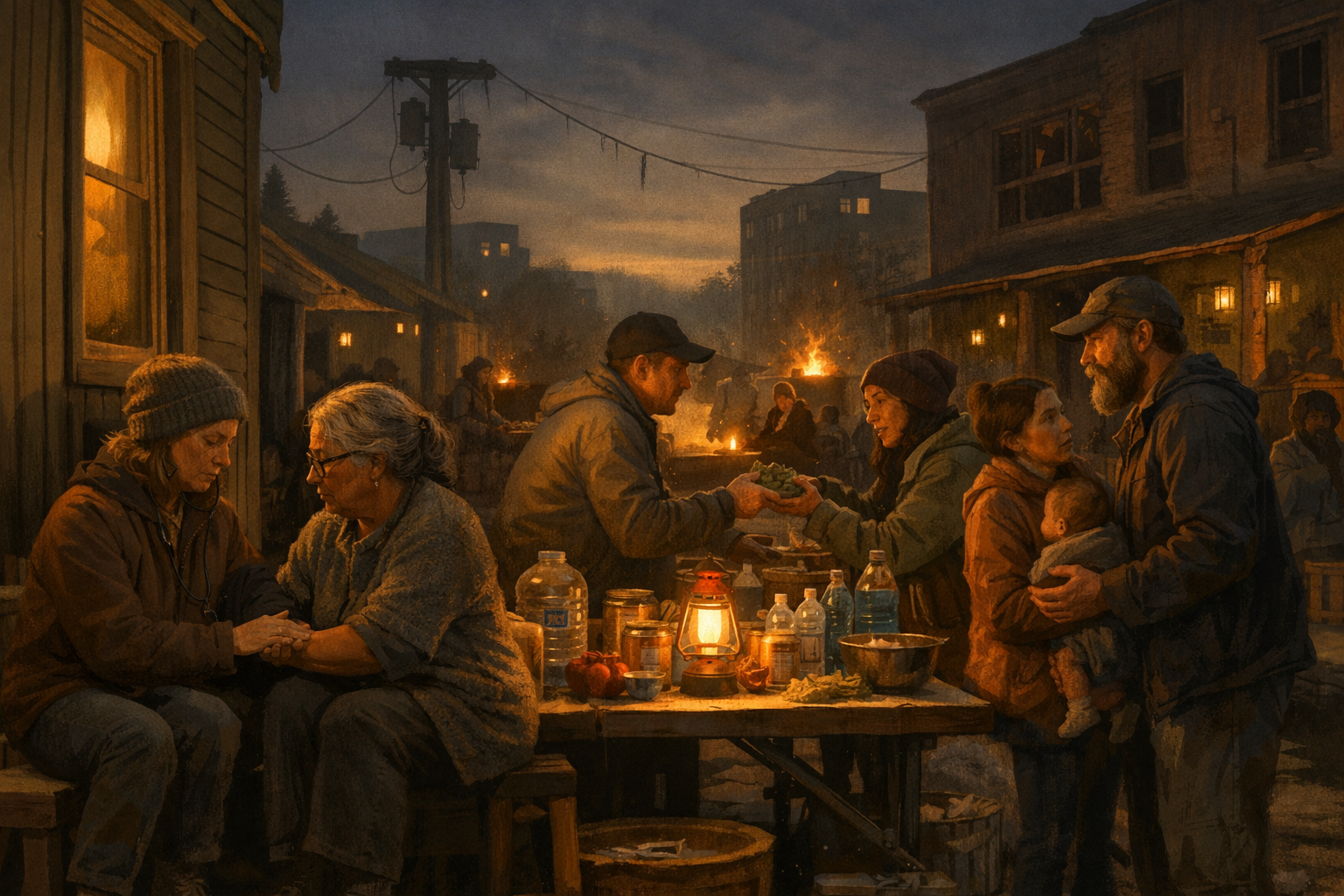
In long emergencies, survival doesn’t look like rugged independence. It looks like quiet coordination. It looks like people checking on each other, sharing what they know, pooling what they have, and making decisions together with imperfect information.
Preparedness, in that sense, isn’t about what you can defend.
It’s about what you’ve already built—slowly, patiently, and in plain sight—before anyone was keeping score.