
What the Desert Teaches
In Dune, the desert does not reward vision, only patience. This piece reflects on how sensitivity without surrender leads to catastrophe, and how survival depends on listening to patterns rather than sealing them too soon
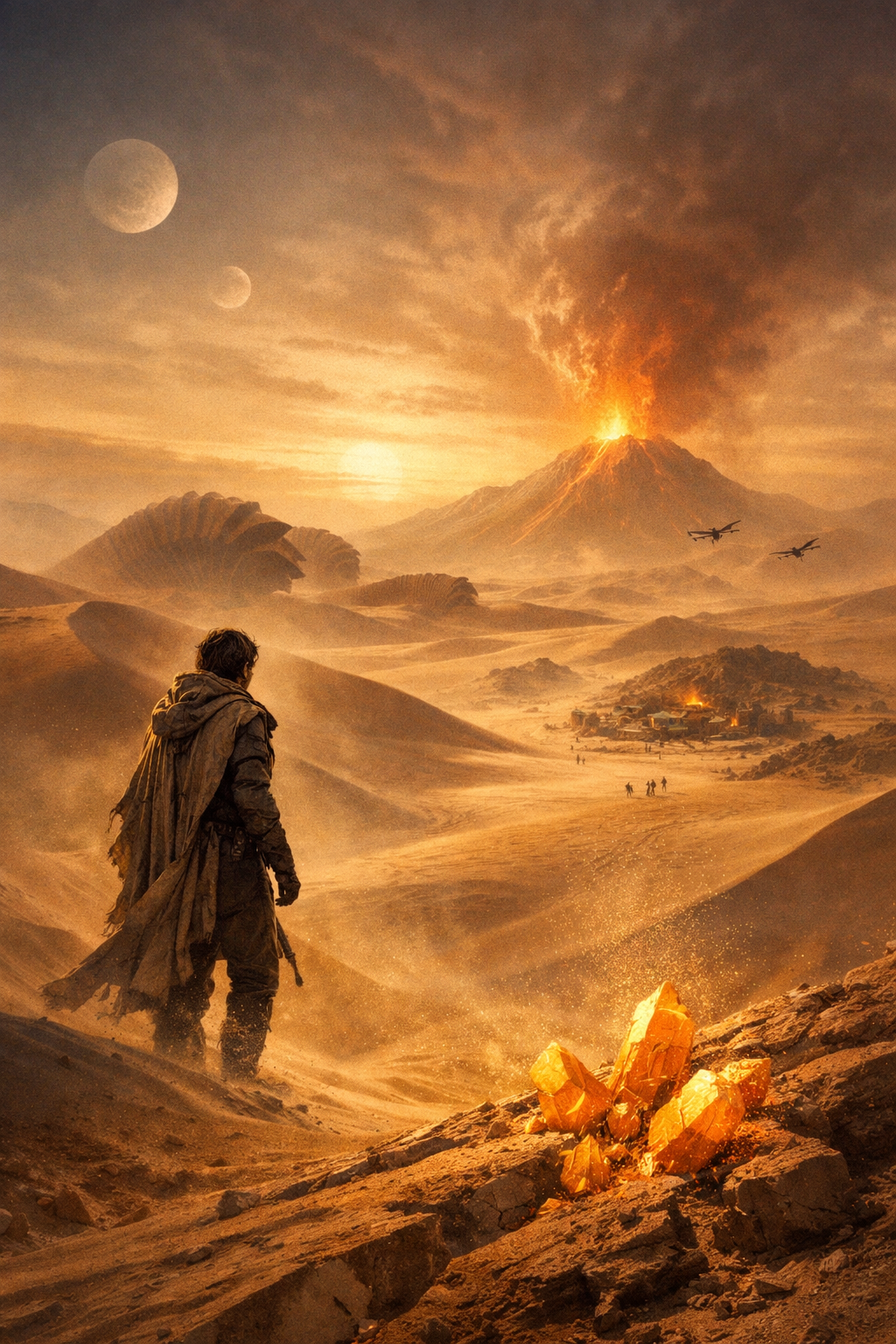
Frank Herbert’s Dune is often described as a warning about power, or as a story about messiahs gone wrong. Both are true, but neither quite reaches the center of the book’s gravity. Dune is not primarily about rulers or empires. It is about pattern—how it forms, how it moves, how it is misread, and what happens when it is forced to resolve before it is ready.
Arrakis is not just a setting. It is a teacher.
The desert strips life down to essentials. There is no excess, no softness, no margin for fantasy. Everything that survives there does so by learning the underlying rhythms of the place: the movement of sand, the scarcity of water, the cycles of worm and spice. On Arrakis, nothing lasts unless it listens.
This is why the spice is not merely a resource. It is the desert’s memory, concentrated. The sandworms do not create it as an act of intention; they metabolize the entire ecology—pressure, time, scarcity, death—until what remains is something that can be carried. The spice is what is left after everything inessential has been burned away. It is pattern, compressed into matter.
Those who consume it do not gain magic. They gain sensitivity.
Prescience, in Dune, is often misunderstood as prediction. It is not seeing what will happen so much as seeing what can happen. The future appears not as a single line but as a field of possibilities, shaped by momentum, constraint, and tendency. To see it is not to control it. In fact, the more clearly one sees, the narrower the viable paths become. Vision is a burden before it is a gift.
This is Paul Atreides’ tragedy.
Paul can see further than anyone before him. He understands the consequences of his actions with terrifying clarity. He knows that the religious war carried out in his name will kill billions. He also knows there exists another path—one that averts that war but demands a sacrifice so total that it would erase the self he recognizes as his own.
And he cannot take it.
Paul’s failure is not ignorance. It is not weakness. It is attachment.
He reaches a point where the pattern asks more of him than he is willing to give. Faced with futures that require his own dissolution—his humanity, his love, his identity—he chooses instead to seal the story early. He accepts a future he can live with, even knowing it is not the one that preserves the whole.
This is the quiet horror at the heart of Dune: catastrophe born not from malice, but from refusal to let the pattern complete its work.
The Bene Gesserit understand this danger, which is why their disciplines are not about domination but about endurance. The Litany Against Fear is not bravado. It is instruction. Fear is treated not as an enemy to be crushed, but as signal to be processed. One does not flee it, nor does one cling to it. One allows it to pass through, observes its path, and keeps only what remains after the surge has gone.
This is the desert’s lesson again: do not force resolution. Let the storm move. Then see what it taught.
Paul sees this intellectually, but he cannot live it all the way through. He stops at the threshold. He chooses a future that preserves a version of himself, and in doing so unleashes forces he can no longer steer. His prescience becomes a prison. Knowing what will happen does not grant freedom if one cannot accept what that knowledge demands.
Herbert does not offer this as a simple moral. He is too careful for that. Paul is not condemned. He is pitied.
The deeper claim is more unsettling: insight alone is insufficient. Sensitivity without surrender leads not to wisdom, but to paralysis or violence. To see the pattern is not enough. One must also be willing to be changed by it.
This is why the desert ultimately refuses heroes.
The most enduring figures in Dune are not those who command the future, but those who learn to move with it. The Fremen survive because they do not attempt to dominate Arrakis. They adapt themselves to it. Their rituals, their economy, even their theology arise from intimate attention to what the desert requires. They do not imagine abundance where none exists. They do not romanticize hardship. They respond, precisely and collectively, to the conditions they inhabit.
Their strength is not individual brilliance, but coherence.
By the time Herbert introduces the Golden Path, the lesson has sharpened. Preservation of humanity does not come through inspired leadership or prophetic clarity, but through an almost unbearable patience: the willingness to hold tension across generations, to absorb suffering without mythologizing it, and to refuse shortcuts that promise relief at the cost of integrity.
In this light, Dune is not a story about destiny. It is a story about timing.
The desert teaches that some things cannot be rushed. Some patterns demand to unfold fully, no matter how uncomfortable that unfolding becomes. Attempts to seal them early—to grasp control, to impose narrative closure, to preserve a preferred self—do not end the process. They only warp it.
Arrakis remembers every shortcut.
And it answers them, eventually, with sand.