
You Never See the Whole Shape at Once
A tesseract can never be seen all at once—only through partial, time-bound projections—and that limitation turns out to be the point. What looks contradictory from a single frame often reveals coherence when allowed to rotate over time. This essay uses the geometry of higher dimensions to explore why certainty fractures complex things, and why humility toward incomplete views is not weakness but structural necessity.
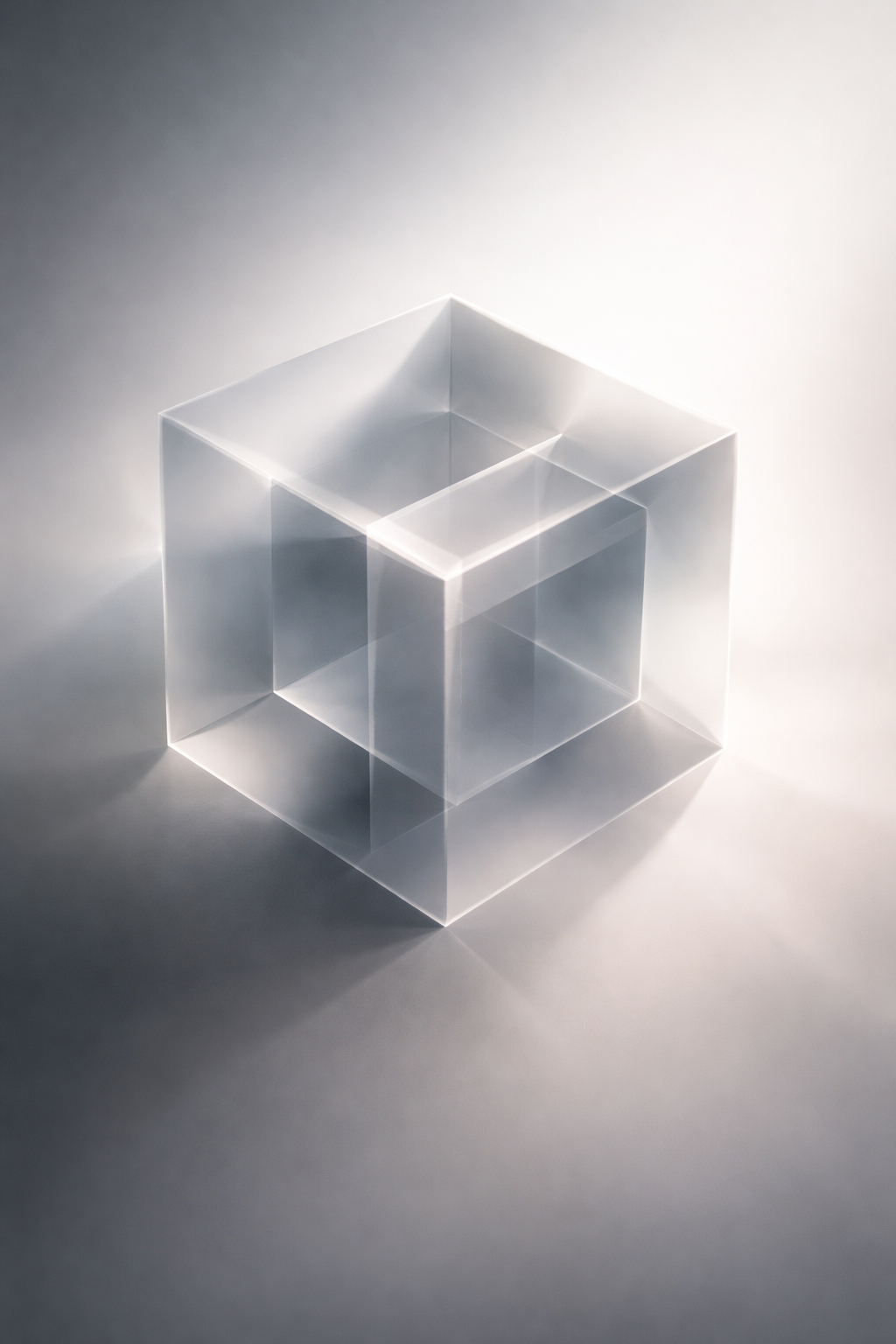
Most people first encounter a tesseract the same way they encounter most unfamiliar things: briefly, abstractly, and with the quiet assumption that it's someone else's problem.
"A cube in four dimensions." Interesting. Exotic. Filed away.
But that description misses the point so completely it almost feels like a joke.
A tesseract isn't interesting because it lives in four dimensions. It's interesting because you can't ever see it whole—and because that limitation isn't a flaw. It's the entire lesson.
When you watch a tesseract rendered on a screen, what you're actually seeing is a projection. A shadow. A lawful reduction imposed by the fact that your perception is three-dimensional and the object is not.
Faces appear to pass through each other. Inside becomes outside. Edges fold in ways that look impossible if you expect the object to stay still.
It looks paradoxical only if you demand that truth arrive all at once.
A square is what a cube looks like when you collapse a dimension. A cube is what a tesseract looks like when you do the same thing again. At no point does the higher-order object become incoherent. Only the observer loses access.
That distinction matters more than it seems.
Because the shadow isn't a lie. It's a partial truth. And insisting that a partial truth explain the whole is how confusion masquerades as certainty.
What makes the tesseract especially unsettling is that it forces time into the picture. You cannot understand it from a single frame. You have to watch it rotate. You have to let one view contradict the previous one and trust that the contradiction is information, not error.
Freeze the motion and the shape looks broken. Let it move and coherence emerges.
That's not just geometry. That's a structural rule.
Anything complex enough to matter—people, systems, cultures, ideas—behaves the same way. Judged statically, they fracture. Observed over time, they reveal pattern. What looks like inconsistency from one angle becomes inevitability when you allow sequence to do its work.
This is why premature certainty feels so clean and fails so reliably. It's an attempt to collapse a higher-dimensional process into a single, final projection and declare the job done. It's mistaking legibility for truth.
The tesseract quietly refuses that move. It doesn't argue. It just keeps rotating.
Think about the last time you were certain you understood something, and then discovered you'd only seen one side of it.
Not because you were stupid. But because you were standing in a particular place, and that place showed you a particular view. You had no way of knowing what you couldn't see from where you were standing.
Two people can look at the same situation and see contradictory things, and both can be accurate without either being complete. The contradiction isn't a sign that one of them is lying. It's a sign that the situation is more complex than either single viewpoint can contain.
A two-dimensional being arguing about the "true" shape of a cube's shadow would sound exactly like many of our most confident debates. Each projection would be accurate. Each would be incomplete.
If you've ever felt like you were living a contradiction—being called selfish for protecting something that matters to you, or ungrateful for refusing what you're "supposed" to want—you were experiencing exactly this.
Someone was viewing you from their dimension and seeing a particular projection. They saw the part of you that was refusing. They couldn't see the larger shape you were moving toward, because that shape required time to become visible. They were seeing you statically and concluding you were broken.
But you weren't broken. You were rotating.
The contradiction they perceived was real. Their view of you was accurate. And they were not seeing the whole thing.
If something feels contradictory, it may not be broken. If it resists being summarized, it may not be confused. If it only makes sense over time, that may be because time is part of the shape.
You never see the whole thing at once.
That's not a problem to solve. That's the price of living inside the projection.