
Returning to the Ground
Boundaries hold as long as consensus does. When they don’t, systems must return to what predates agreement. This essay uses centuries-old boundary markers to explore why re-grounding—not negotiation—becomes necessary under stress.
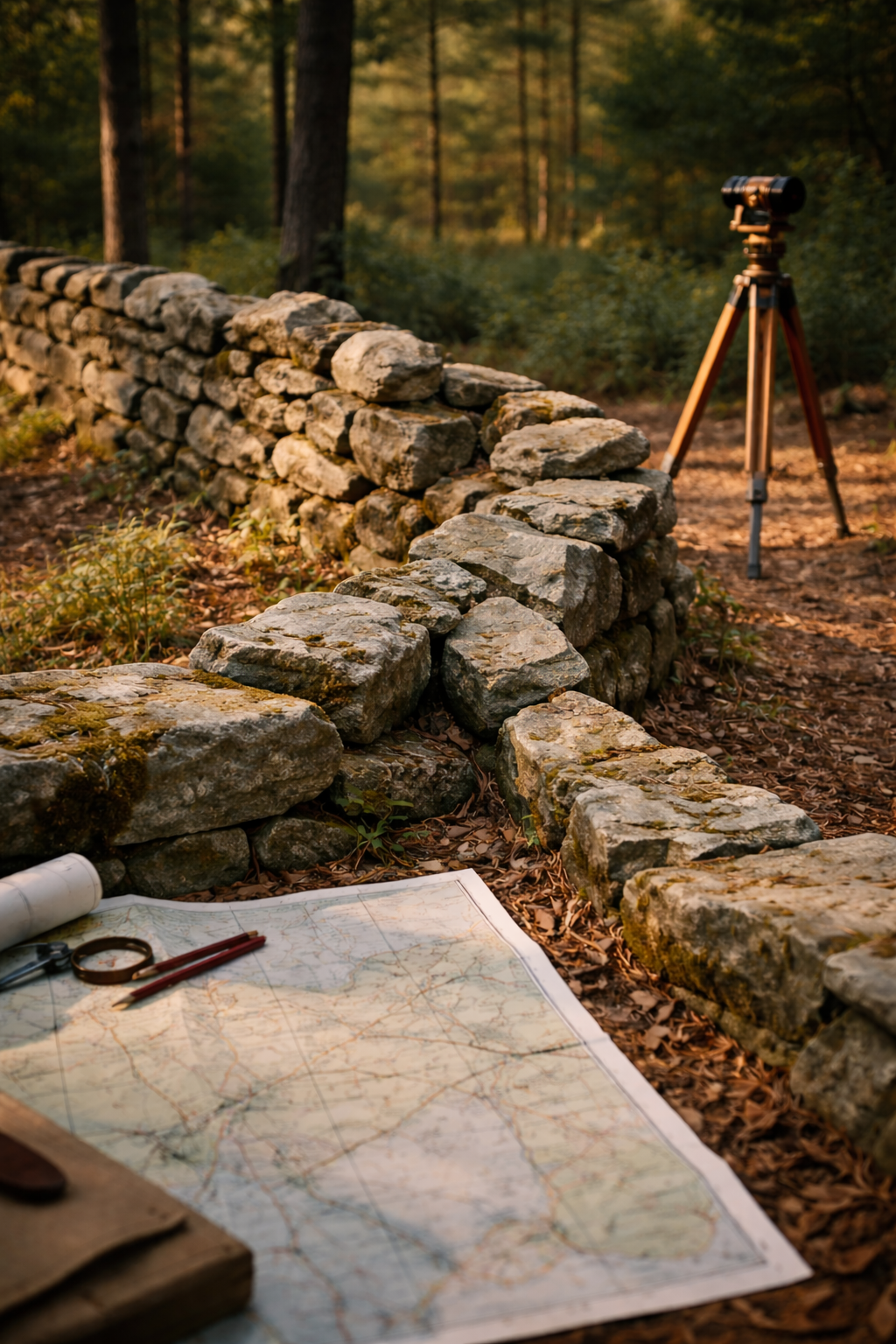
If you wander far enough from where people still live, you start finding things that no longer make sense.
Old stone walls running through woods that haven’t been fields for generations. Boundary markers standing alone, long after the farms, houses, and paths they once referenced have disappeared. Corners marked with care for neighbors who no longer exist. Lines drawn for purposes that time has quietly erased.
Some of these markers are exactly where you’d expect them to be. Others aren’t. They bend around nothing. They stop abruptly. They resume a few yards over, as if someone once realized—too late—that the land didn’t quite match the assumption that had been made about it.
And sometimes you can tell they were moved.
Not erased. Not smashed. Just shifted. A few feet. A few degrees. Enough to reconcile a new road, a redirected stream, a revised understanding of what the map must have meant all along.
These stones are not decorations. They are records of disagreement, resolution, and reorganization. Each one exists because at some point, consensus failed. Someone needed to know where something actually ended, not where it was said to end. Someone paid for certainty when trust alone was no longer sufficient.
What’s striking is how long they last.
People leave. Villages vanish. Institutions dissolve. Titles change hands. But the stones remain, quietly asserting that at some moment in the past, it mattered enough to put the boundary in the ground rather than in memory.
Most of the time, we don’t notice them because we don’t need to. As long as everyone agrees, boundaries can be social. They can be inherited. They can be enforced by habit and reinforced by repetition. We trust that what we were told lines up with what is actually there.
That trust is efficient. It’s also fragile.
Eventually, ownership changes. Or incentives shift. Or the surrounding structures reorganize. The old owner leaves the scene, and the neighbors start telling slightly different stories about where the line has always been. The markers still stand, but no one is quite sure anymore whether they were placed correctly—or whether they were nudged over time to accommodate convenience, pressure, or power.
That’s when someone calls a surveyor.
Not to invent a new boundary, but to return to a deeper one. To reconcile the visible markers with the canonical source of truth that predates the arguments now being had. The map isn’t consulted because it’s abstract, but because it anchors the abstraction back to something contractual, something paid for, something that existed before memory drifted.
The survey doesn’t erase the old stones. It explains them. It reveals which ones were placed carefully, which ones were compromised, and which ones only made sense under conditions that no longer apply.
Modern systems tend to resist this move.
We prefer boundaries that can be adjusted later, reconciled retroactively, or appealed through process. We substitute claims for custody, entitlement for presence, assurances for continuity. As long as everything remains stable, this works well enough. The difference between where the boundary is and where it is said to be rarely matters.
Until it does.
Under stress, the question changes. People stop asking what should happen eventually and start asking what is true now. They don’t want the story of how things will be made right later. They want to know where the line actually is. Who holds the keys. What still exists independent of promises that require the system to remain calm in order to be honored.
Rebuilding always starts there.
Not with the most sophisticated abstractions, but with what can be pointed to. What can be walked. What can be verified without permission. The ground does not negotiate. It does not scale. It does not update itself to match our expectations. It simply is.
This is why returning to the ground feels uncomfortable. It strips away the convenience of inherited agreement and exposes the accumulated drift we preferred not to notice. It reveals that some boundaries were provisional all along, and others were only ever enforced by the absence of pressure.
The old stones scattered through abandoned places are reminders of this cycle. They mark not permanence, but recurrence. Again and again, systems abstract away from the ground. Again and again, stress forces a return.
The mistake is not abstraction. The mistake is forgetting what it rests on.
When the time comes to re-ground, the question is never whether the boundary should exist. The question is whether it will be rediscovered honestly—or redrawn in a way that merely replaces one misalignment with another.
The land will remember either way.