
Seeing It Coming Isn’t the Same as Being Ready
It’s possible to recognize where things are heading and still be unprepared when they arrive. This essay explores the gap between intellectual foresight and emotional readiness—why slow, structural change can be visible for years without being fully integrated, and why its consequences still feel shocking when they become concrete. By examining how humans process time, risk, and decline, it argues that awareness alone is not enough. Readiness requires letting implications land early, before events force them into view.
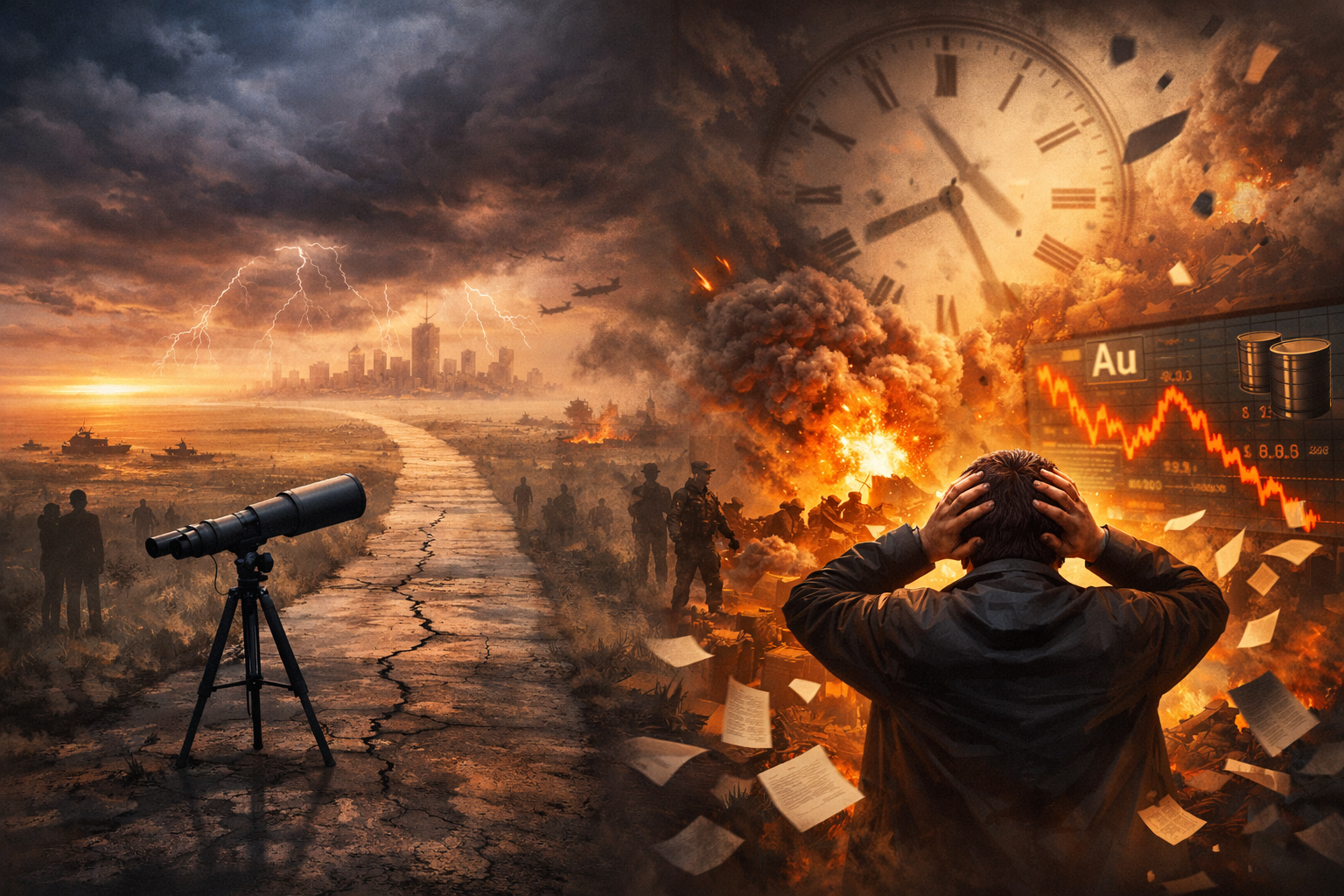
There’s a strange psychological gap that opens up during long declines.
You can see where things are heading. You can name the forces at work. You can even say, out loud, “This is going to end badly.” And yet, when the thing finally arrives—when the abstract becomes concrete—it still lands with a kind of shock.
Not disbelief.
Not confusion.
Shock.
This isn’t hypocrisy, and it isn’t stupidity. It’s something more structural than that.
Humans are surprisingly good at anticipation in theory and remarkably bad at integration over time. We can model outcomes years in advance while remaining emotionally calibrated to yesterday. We mistake foresight for readiness, because both use the same language. But they live in very different parts of us.
Knowing something might happen does not mean you have lived inside its implications.
Most warnings arrive first as concepts. They’re distant, conditional, and framed in hypotheticals. “If this continues…” “At this rate…” “Eventually…”
Those phrases keep danger politely abstract. They allow us to hold awareness without having to reorganize our inner world. As long as something remains hypothetical, it doesn’t require adaptation—only acknowledgment.
That’s why people can talk about institutional decay, democratic erosion, or systemic instability for years without feeling urgency. The mind registers the pattern, but the body doesn’t feel the weight. The consequences are still somewhere else, still later, still avoidable by unseen guardrails.
But guardrails don’t usually fail all at once. They fatigue. They thin. They bend long before they snap.
And that’s where the disconnect forms.
Slow change doesn’t register as danger in the same way sudden change does. It feels survivable. Each step is small enough to normalize. Each moment still resembles the one before it closely enough to preserve continuity. Normalcy doesn’t disappear; it narrows.
By the time something unmistakable happens—something that can no longer be described as theoretical—the emotional system is still calibrated to a world that no longer exists.
That’s when people say things like, “I knew this was coming, but I didn’t think it would actually happen,” which sounds contradictory until you understand what they’re really saying.
They knew in one register.
They weren’t ready in another.
This gap becomes especially visible when people disagree about timelines.
Short timelines are comforting. They place responsibility close to the present. They imply a clean break: before and after, then and now. They preserve the idea that something went wrong recently and could therefore be fixed by reversing course.
Long timelines are uncomfortable. They imply continuity. They suggest that what we’re experiencing is not an aberration but an accumulation. That the structures we relied on were already compromised while they still seemed functional. That there may not be a clean “normal” to return to, because normal itself was part of the process.
People don’t resist long timelines because they’re inaccurate. They resist them because they collapse moral distance.
If decline has been gradual, then many of us were participants, beneficiaries, or at least comfortable passengers while it unfolded. That’s not an accusation—it’s a recognition of how large systems work. But it’s still difficult to sit with.
So we default to moments instead of processes. Villains instead of dynamics. Events instead of trajectories.
And when reality finally catches up to the warnings, the shock isn’t just about what happened. It’s about the sudden loss of the story that said, “This can’t really happen here.”
What’s important to understand is that this reaction doesn’t mean people were asleep. It means they are human-scale beings living inside system-scale change.
Our nervous systems evolved to respond to immediate threats, not multi-decade drift. We’re good at reacting. We’re not great at rehearsing emotionally for futures that arrive slowly.
Which means that surprise, in these moments, is not evidence of blindness. It’s evidence of lag.
Seeing something coming is a cognitive achievement.
Being ready requires something deeper.
Readiness means letting implications land early, before they’re forced on you. It means allowing discomfort before it’s unavoidable. It means revising internal expectations while the external world still looks familiar.
Most of us aren’t trained to do that. We’re trained to optimize for continuity, not for rupture.
So when rupture arrives—when the abstract turns concrete—we experience a kind of temporal vertigo. The mind says, “Yes, this fits the model,” while the body says, “This shouldn’t be happening.”
Both are telling the truth.
If there’s a lesson here, it isn’t about being smarter, louder, or more predictive. It’s about learning the difference between awareness and readiness—and recognizing that the second requires more than analysis.
It requires time spent with uncomfortable implications.
It requires widening the frame before it collapses.
It requires emotional preparation, not just intellectual agreement.
Because seeing it coming is not the same as being ready.
And in periods of slow, structural change, that difference matters more than we like to admit.