
The Wrapper
When social infrastructure erodes, communities don't just lose information. They lose orientation.
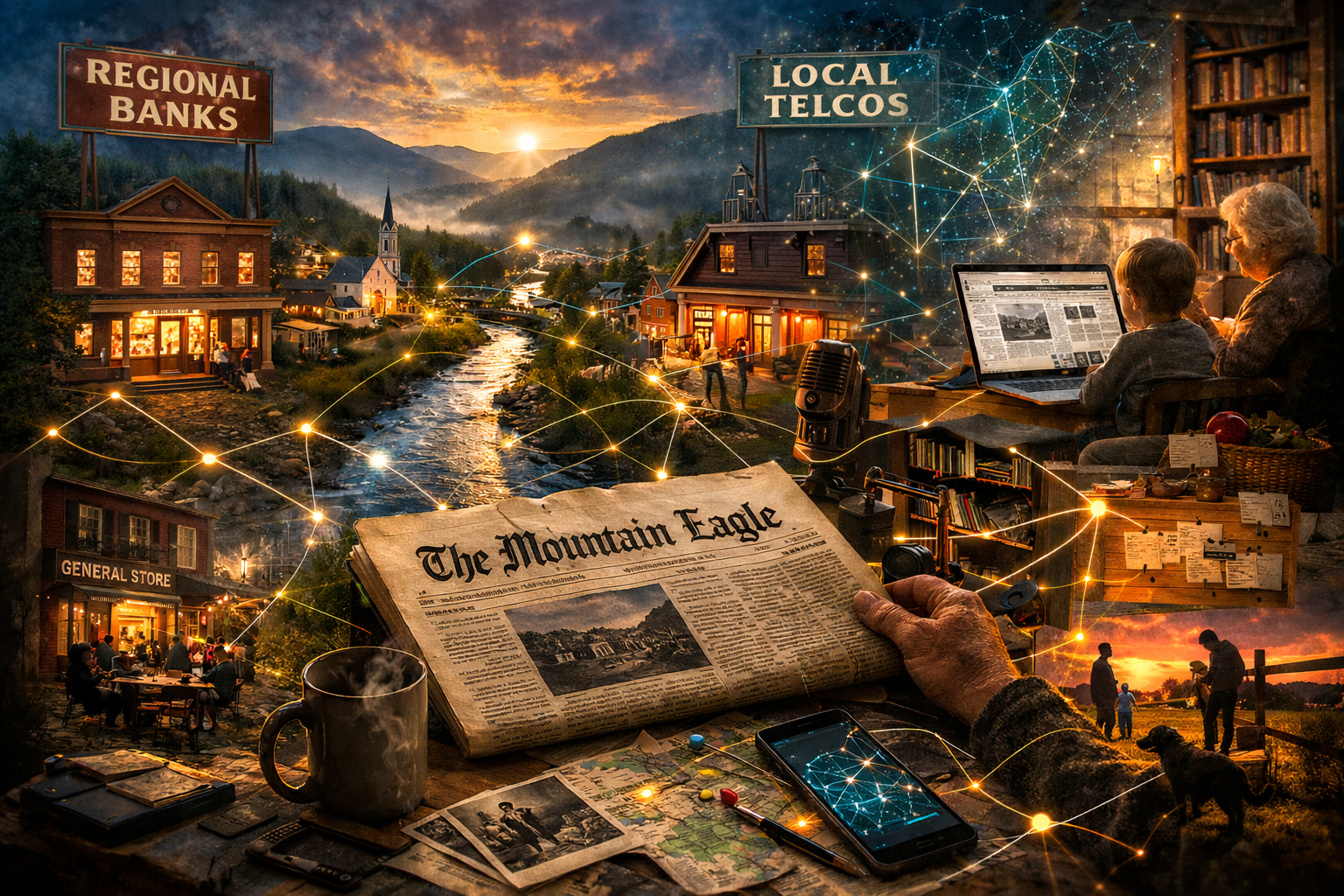
A regional newspaper in the Catskills went online last month.
If that's enough, it's enough. The Mountain Eagle is at MountainEagle.net. Subscribers can log in and find their paper. People in Florida can read it. The radio plays without ads. There's a place to list what you're selling and find what you need. The community is there, if you want it.
That's the whole story, if that's what you came for.
---
For everyone else, here's what actually happened.
Not the launch. The launch was two weeks. What happened took twenty years — and the last six were spent building it, and those six required a version that failed, and the failure required a flood, and the flood was preceded by a signal seen in 2006 that couldn't be unseen, and the signal pointed to something so structural and so slow that most people won't feel it until it arrives all at once.
But I'm getting ahead of myself.
---
In 2006, I started paying attention to something most people weren't watching yet.
Not a market. Not a trend. A structural condition — the kind that doesn't announce itself with headlines.
It shows up first as a vague wrongness in the prices of ordinary things and then as institutional behaviors that only make sense if you assume the people making decisions know something they aren't saying out loud, and then, eventually, as a flood.
Hurricane Irene hit Schoharie County in 2011.
We lost houses, roads, businesses. We lost the kind of continuity that floods take that nobody puts in the damage estimates — the people who looked at what happened and decided not to come back, the families who had been thinking about leaving and now had a reason, the young people who might have stayed and didn't. Since 2010, our town has lost 22.5% of its population.
That's not a statistic. That's the diner getting quieter. The school consolidations. The hardware store wondering about its future. The knowledge that used to transfer between generations at the kitchen table finding fewer tables to land on.
I watched this and kept watching, and somewhere in the watching a question formed that wouldn't leave me alone:
*What's missing?*
Not what's broken. What was never there. What should have been built but wasn't. What, if it existed, would change the structural condition rather than just describing it.
---
The answer I kept arriving at was: a wrapper.
The pieces were all present. A newspaper that had been showing up every week for generations. A local telco. A regional bank. A community radio station. Local businesses and government along with families that have roots going back further than anyone bothered to count. Clean water that flows downhill to a city of eight million people who mostly don't know where it comes from.
All of it present. None of it held in coherent relationship with itself.
The coordination layer that used to exist informally — through daily contact at the hardware store, at the diner, at church, at the school — was eroding without replacement. The generations were separating into silos. The knowledge that could only travel through sustained proximity was finding fewer channels. The institutions that held community memory were doing it alone, without infrastructure, without digital presence, without the kind of durability that would let them still be here in twenty years.
Something was missing.
Not content. Not more media. Not a better website.
A wrapper. The thing that holds the pieces in relationship with each other and with the community they serve. The layer that makes local coherence legible and durable — to itself, to its members, to the generations who haven't arrived yet.
---
I began building it in 2019.
Version one failed. I used everything it taught me to build version two. The crypto winter of 2022 was draining in ways I won't fully describe. The consulting work that funded the build went on longer than I planned. The tools I needed weren't ready when I started. They arrived, more or less, on schedule.
I am not a young man starting a project. I am someone who saw something in 2006, felt a duty to act even knowing the action might be ineffective, and spent the intervening years building the thing that was missing.
Whether it works is genuinely unknown. It's a good theory. We'll see.
---
What I built is not a media company.
A media company asks: *what content should we create to capture attention?*
What I built asks: *what conditions must exist so that real life can coordinate?*
Those are not the same question.
At its best, the local newspaper was never primarily a media company. It was infrastructure. Closer to a road than a billboard. Closer to a well than a performance. You didn't opt into it because it was exciting. You relied on it because it was there — consistently, quietly, doing its job.
When that function erodes, communities don't just lose information. They lose orientation. Everything feels new, even when it isn't. Issues repeat without recognition. Trust thins — not because people disagree, but because there is no longer a shared place to remember from.
MountainEagle.net is an attempt to restore that function. And extend it.
The platform underneath the newspaper handles subscriber management, advertising operations, events, community calendars, local commerce with full payment processing and tax collection, a media player for community and regional radio, real-time messaging, photo galleries, curated video, and a marketplace where neighbors can transact directly.
It runs on hardware we own, in a data center in the region, with mail infrastructure we control, with partnerships with local institutions who have skin in the same game we do.
The data stays where the accountability lives.
---
There is a deeper architecture underneath all of this that I won't describe in full here, because it isn't ready to be described in full yet. It involves identity systems that reflect real relationships in a community — not just passwords and usernames. It involves a protocol for how individual nodes — human and institutional — form trust relationships that can be verified without being coerced.
I mention it only to say: what you see at MountainEagle.net is the surface of something that goes considerably deeper.
The PDF that our elders can intuitively find immediately upon login is the same system that could, under different conditions, anchor a local economic network that doesn't depend on the purchasing power of a currency.
Long term stability should be of concern to anyone who has been paying careful attention with the right framing.
For now, the PDF is enough. The PDF is everything.
The rest is the seed vault.
---
The model we are building toward is cooperative.
Publisher entities collectively owning the infrastructure. Local institutions governing it rather than distant capital. New nodes joining as the pattern proves itself. The template replicating — not as a franchise, not as a product, but as a pattern that any community with the right conditions can pick up and enact.
Sparse population. High trust. Multi-generational families and small businesses. Local institutions that still have integrity. A watershed worth protecting.
Those conditions still exist in more places than the national conversation acknowledges. The Catskills is one of them. There are others.
If this works here, somebody else can copy it. That's not a concession — it's the design. The value stays where it's built. The template travels freely. The federation forms one node at a time, each one sovereign within its domain, each one connected to the others by chosen cooperation rather than imposed dependency.
One hand washes the other. Both wash the face.
---
I am not trying to win the internet.
I am trying to tend a commons — in four counties in upstate New York, in a watershed that supplies water to a city that mostly doesn't know we exist, in a community that has been losing people since a flood that happened before most platforms currently fighting for attention had been invented.
I am trying to build something that degrades gracefully rather than catastrophically. That preserves continuity long enough for judgment to arrive. That holds the knowledge that needs to transfer between the generation that has it and the generation that will need it.
I am trying to build the stage.
What happens on it belongs to the community.
---
A grandmother tells her grandson: you can get the paper and listen to WIOX 91.3 FM while you're in Florida.
That's the whole pitch.
Everything else is infrastructure.