
Understanding Network Effects
Network effects aren't just about user growth—they're about dimensional expansion. Each true point added to a network creates n-1 new relationships, exponentially increasing navigable space and enabling higher-resolution understanding. The real value emerges not from size but from geometric complexity: more dimensions mean richer context, better navigation, and the capacity for patterns to emerge that weren't present in individual elements. Networks that preserve learning capacity can discover new dimensions and reorganize without shattering; those that optimize for growth alone eventually collapse under their frozen geometry.
“Network effects” is one of those phrases that gets used so often it starts to feel explanatory even when it isn’t. It shows up whenever a platform grows too fast to compete with, whenever a product wins despite being technically inferior, whenever a monopoly hardens and someone wants a neutral-sounding reason why. Each new user adds value for every other user. The flywheel spins. Scale begets scale. End of story.
That story isn’t wrong. It’s just shallow.
What it misses is that network effects are not primarily about growth. They are about space. More precisely, they are about the sudden appearance of new dimensions once enough real points come into relationship.
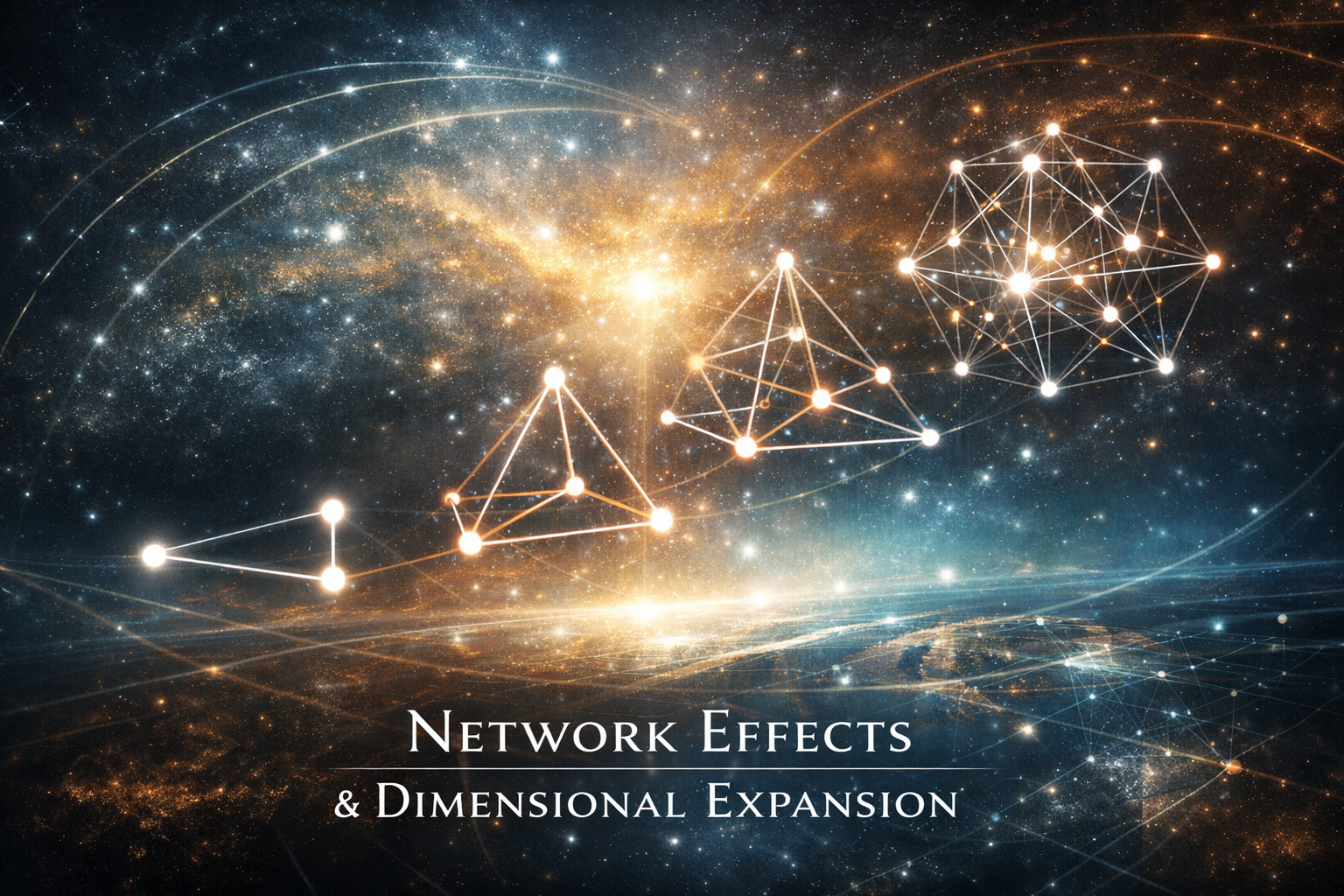
Start with the simplest case. Two points give you a line. A single axis. A yes and a no. A for and an against. Nothing can exist between those points except tension. Add a third point and something unexpected happens. You don’t just get another connection, you get a plane. A bounded surface. A place where relationships can move without collapsing into opposition. The triangle is the first stable shape for a reason.
Add another point and the structure lifts off the page. Volume appears. Not metaphorically—mathematically. Each additional point doesn’t merely attach itself to the network. It forms a relationship with every point already present. The number of connections grows faster than the number of points, and with that combinatorial growth comes dimensional expansion. The network stops being a collection of links and becomes a navigable space.
This is the part most discussions skip. The value of a network isn’t that there are more things in it. The value is that there are more ways to be positioned. With enough genuine points in relationship, you can finally stop flattening reality to make it manageable.
Anyone who has tried to describe something complex using only binaries knows this instinctively. Good or bad. Success or failure. Safe or dangerous. The compression is violent. Almost all the information is lost. What actually happened doesn’t survive the telling. But introduce a handful of irreducible concepts—ones that don’t collapse into each other under pressure—and suddenly the geometry holds. You can say that something carried compassion and honesty in tension, that humility was present but resolve was not, that wisdom showed up without courage. The description doesn’t just sound more refined. It becomes accurate.
That accuracy comes from dimensionality. From having enough true points that meaning can exist in the relationships between them rather than being forced onto a single axis.
Not all points contribute this way. Some are load-bearing. Others are projections—useful shorthand, perhaps, but not genuine dimensions. A true point is irreducible. It keeps generating relationships no matter how many times you traverse the network. It doesn’t collapse into a combination of other points once you look closely. Wisdom behaves like this. Compassion does too. So does humility. They remain distinct under iteration. They create structure.
Projected points don’t. They look like dimensions until you lean on them. “Success,” for example, often turns out to be nothing more than other values viewed from a convenient angle. Adding projections increases noise, not space. The network gets busier without becoming more navigable.
This distinction explains why some networks grow without improving. They accumulate points that don’t expand dimensionality. The surface area increases, but the geometry stays the same. Nothing new becomes possible.
The most common failure mode is collapse into versus. Left and right. Freedom and security. Individual and collective. These frames pretend to clarify, but what they actually do is crush multidimensional reality onto a line. They don’t resolve tension; they eliminate it by force. Once you’ve collapsed the space, the only remaining move is dominance. Pick a side. Declare victory. Seal the question.
That sealing is premature. Reality does not live on a line. It never has. Any position worth taking occupies many dimensions at once, some held strongly, others lightly, some in active tension. When discourse refuses to admit that dimensionality, the information loss is catastrophic. The network effect runs in reverse. Instead of emergence, you get flattening. Instead of understanding, you get noise amplified by scale.
When enough true points do come into relationship, something else appears that isn’t contained in any single one of them. A field. You can hear this in music. Two notes form an interval with a character neither note possesses alone. Three notes form a chord. Enough notes form a key, a tonal field with gravity, tension, and resolution. The field isn’t stored anywhere. It exists in the geometry.
The same thing happens with ideas, with virtues, with people. A community with enough real dimensions doesn’t just connect individuals; it generates a shared space of meaning. Context stops needing explanation because it’s carried implicitly by position. A word, a gesture, a pause can convey what paragraphs cannot, because everyone involved is oriented within the same field.
This is also where learning lives. A network that can explore its own space, notice misalignment, and reconfigure itself preserves the ability to adapt. One that optimizes only for scale freezes its geometry early and mistakes rigidity for stability. When reality shifts—as it always does—the frozen network fractures. Size offers no protection. Brittleness is a structural outcome, not a moral one.
Context, in this light, isn’t something you tack onto a statement. It is your location in multidimensional space. Low-dimensional networks can’t preserve it; there aren’t enough axes to encode what matters. High-dimensional ones do so naturally. Meaning survives compression because the geometry itself carries information.
This is why network effects feel exponential when they work. Not because of some mystical law, but because there is a phase transition once dimensionality crosses a threshold. Somewhere around seven to twelve true points, the network stops behaving like a collection and starts behaving like a field. New patterns become possible that no participant could have predicted or produced alone.
The practical implication is deceptively simple. If you’re building anything—a platform, a community, a body of knowledge—the question isn’t how many points you can add. It’s whether each addition expands the space. Does it introduce a new irreducible dimension, or does it merely repeat an existing one under a different name? Does it create new relationships that hold under iteration, or does it clutter the geometry?
And when faced with complexity, resist the urge to collapse it prematurely. Compression has its place, but seal too early and you destroy the very emergence you were trying to harness. The value was never in the connections themselves. It was in what became possible once enough true points were allowed to coexist without being forced into opposition.
Network effects aren’t magic. They’re geometry. More true points create more relationships. More relationships create higher dimensions. Higher dimensions allow fields to form. Fields preserve context. Context enables learning. Learning discovers new true points, and the cycle continues.
Once you see it this way, it’s hard not to notice it everywhere. Everything is a network. The only real question is whether it’s expanding dimensionality—or collapsing it.