
When Claims Replace Custody
Modern systems increasingly substitute abstract entitlement—claims, credits, assurances—for physical continuity at the exact moment continuity matters most. This essay explores why that substitution feels acceptable during stability, why it fails during systemic stress, and why rebuilding always starts from what still exists rather than what is promised later.
There is a particular sentence no one wants to hear at the wrong moment.
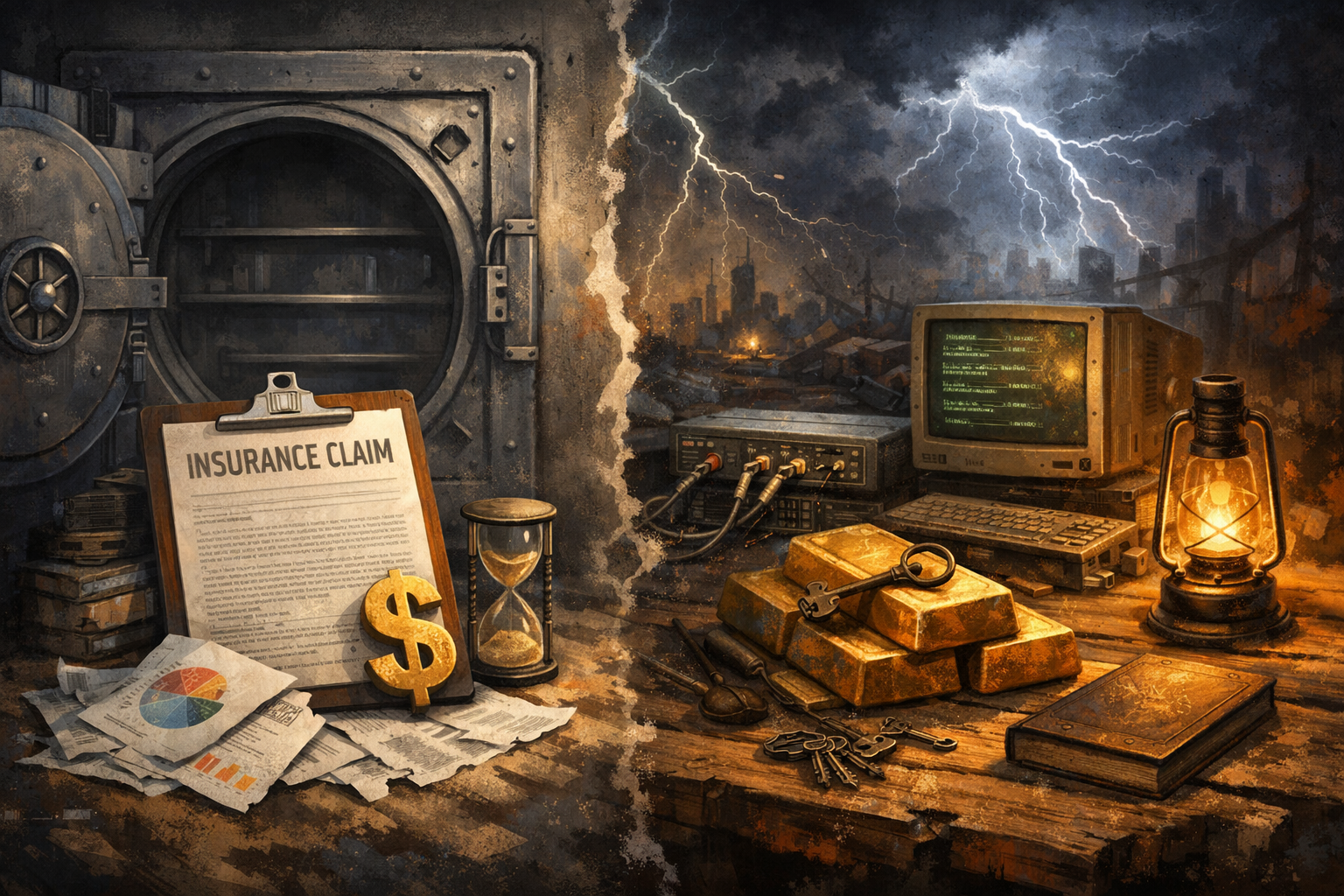
The vault is empty, but there’s an insurance claim.
The data is inaccessible, but there’s a ticket number.
The account is frozen, but an appeal is pending.
The system failed, but restitution will arrive later.
On paper, these are reasonable responses. In practice, they reveal a substitution that only works while conditions remain calm: abstract entitlement standing in for physical continuity.
Most of the time, this trade feels harmless. Efficient, even. We accept claims instead of custody because custody is expensive, slow, and requires care. Claims are portable. They scale. They can be reconciled later. In stable systems, later reliably arrives, and the unit of account still means something when it does.
The trouble begins when abstraction fails precisely where it was meant to protect us.
Insurance only works when failures are local. Appeals only matter when time still exists. Credits are only meaningful when the system honoring them remains solvent. The moment failure becomes correlated—monetary, institutional, infrastructural—the promise of being “made whole later” collapses into theater. The entitlement survives on paper, while continuity vanishes in fact.
This isn’t fraud. It’s structure.
We built systems optimized to act instantly and reconcile slowly. Execution outruns judgment. Enforcement outruns deliberation. The remedy is designed for a world that assumes the ground beneath it is stable. When that assumption breaks, claims reveal themselves as narratives told too late.
That’s why these moments feel so shocking. Not because something failed, but because the relationship failed. The customer thought they were entrusting something to a custodian. What they discover, at the worst possible time, is that it was handed off to a chain of abstractions that cannot act in the present. Everyone involved may be acting in good faith. No one can restore continuity now.
The system offers paperwork in place of presence.
This pattern isn’t confined to finance, or data, or platforms. It shows up wherever responsibility is deferred upstream and accountability is priced for average conditions rather than tail events. It shows up when services become interfaces, when custody becomes tenancy, when legitimacy is retroactive.
And when things break badly enough, people stop asking for claims.
They ask where the thing is.
Who has the keys.
Whether it can be reached today.
Who can act without permission.
Rebuilding always begins there—not with the most powerful systems, but with the ones that still exist when the lights flicker. Physical machines. Local networks. Human relationships. Processes that degrade rather than erase. Things that don’t require the world to remain sane in order to function.
This is why appeals to scale feel hollow during instability. Scale depends on abstraction holding. When abstraction cracks, continuity doesn’t come from promises—it comes from presence.
The mistake wasn’t trusting systems. It was mistaking entitlement for custody, and assuming the substitution would hold under stress.
Resilience is not the promise of being made whole later.
Resilience is not needing to be made whole at all.
Everything else is insurance written in a currency that only clears while nothing truly important is breaking.